
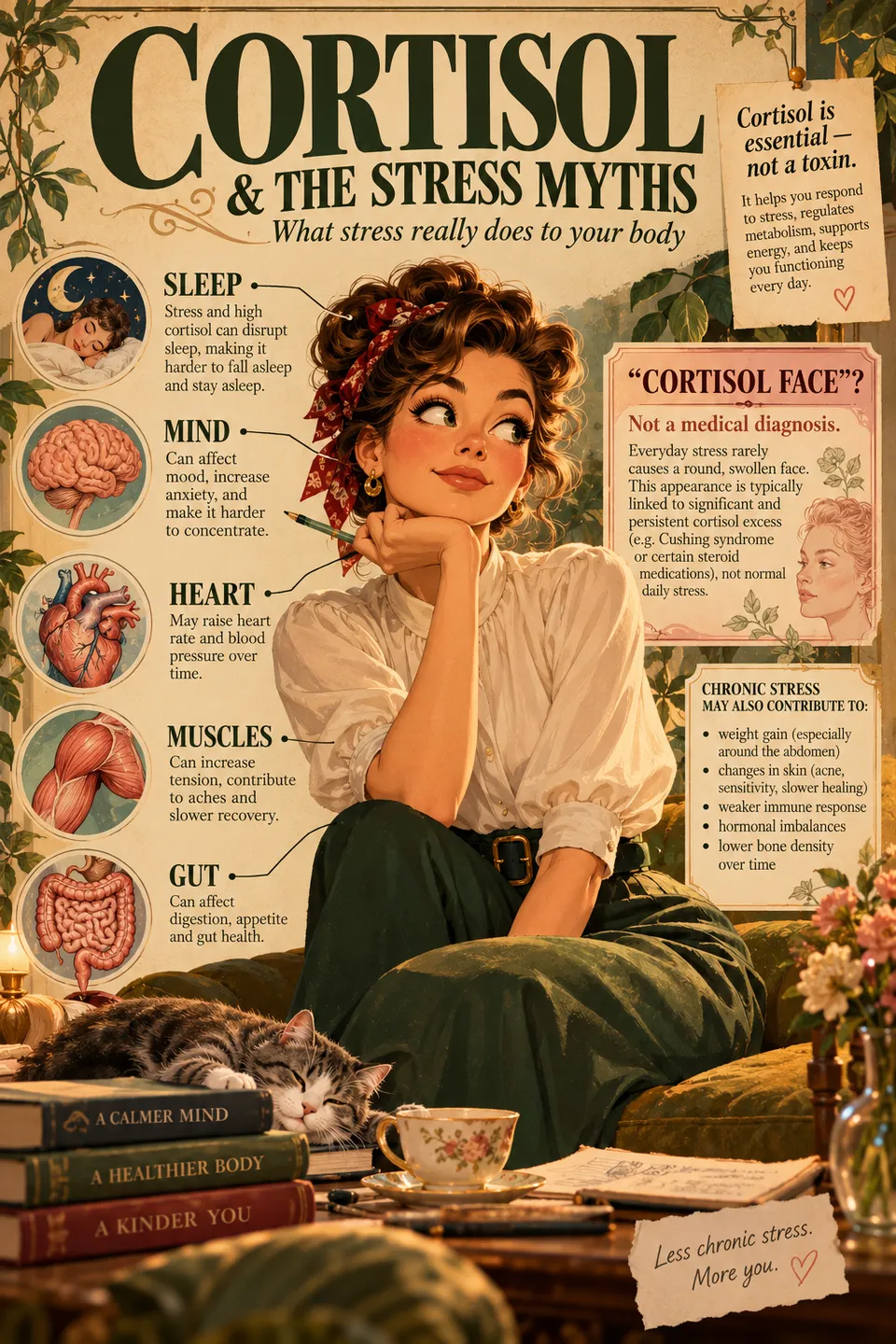
You caught your reflection in a shop window and it looked tired in a new way. Rounder, somehow. Then you saw the video: that is cortisol face, the stress hormone is swelling your cheeks, here is a supplement.
Pause there. Cortisol face is clever marketing: it takes something true, that stress lives in the body, and attaches it to something you can see in a mirror and fix with a purchase.
What does cortisol actually do?
Cortisol is made by your adrenal glands, two small caps on top of the kidneys, under instructions from the pituitary. According to the US National Library of Medicine's MedlinePlus, it helps your body respond to stress, keeps inflammation in check, regulates blood sugar and metabolism and helps control blood pressure.
It also runs on a clock. Levels peak in the morning to get you upright and fall through the afternoon. That morning surge is not a malfunction. It is the reason you eventually leave the bed.
Cortisol is a rhythm, not a leak; the question is never "do I have it" but "does it still come and go."
Is cortisol face real?
There is a medical condition where excess cortisol really does round the face. It is called Cushing's syndrome, and the NHS describes a red, round face along with fat around the neck and upper back, easy bruising and purple stretch marks. The most common cause is long-term high-dose steroid medication, not a stressful job.
And it is rare. The Endocrine Society puts Cushing's disease at roughly 10 to 15 people per million each year.
Per million. The odds that the face in your shop window is a hormonal disorder are low. The odds that it is salt, alcohol, poor sleep, crying, allergies, or simply Tuesday are considerably higher.
A puffy face is almost never cortisol; it is usually last night.
Where chronic stress really shows
This is where the trend accidentally points at something worth your attention. Stress does live in the body. It just prefers places you cannot photograph.
The World Health Organization lists the common signatures: trouble relaxing or concentrating, headaches and body pain, an upset stomach, disturbed sleep, appetite swinging in either direction, irritability, and old health conditions flaring up.
Notice what is on that list. Jaw. Gut. Sleep. The way your shoulders have been living near your ears since spring. None of it is visible in a selfie, which is exactly why a selfie-sized explanation is so tempting.
In body-oriented therapy we tend to ask a different question. Not "what does stress look like?" but "where do you go quiet?" The body part you stopped noticing is often the one carrying the load.
Stress you can see is a face in a mirror; stress you can feel is a body you stopped listening to.
The Substance, and the economy of being looked at
Coralie Fargeat's The Substance is a horror film about a woman who injects herself into a younger, smoother version of herself and then has to share a life with it, one week each. What makes it unbearable is not the gore. It is how reasonable Elisabeth's first decision feels. Of course she wants the other body. Everyone is telling her the one she has is a problem.
Cortisol face is a tiny, legal version of that offer. Here is your flaw. Here is the name for it. Here is the thing to buy. The film shows what happens when the exchange rate between how you feel and how you look collapses entirely: the feeling body is discarded, and the looked-at body takes everything.
The stress economy sells you a mirror when what you need is a mouth that can say "I am not okay."
Try this with a card
Metaphoric cards are useful here precisely because they are not mirrors. They give the body a picture to speak through, rather than a flaw to fix.
- Draw. Pull one card, ideally in the evening, when the day has settled into you. Ask: where is the stress living today?
- Look. Hold the image at arm's length. Then slowly scan your own body from scalp to feet, and notice which part of you the card seems to be about.
- Two questions. Ask the card: what has this part of my body been doing for me? Then: what would it need in order to clock off?
If you want a map of where feelings tend to sit, the Emotion map on this site is a good companion to the exercise. Many people find the place they point to is not the place they expected.
If your face or body has changed quickly and markedly, or you are on long-term steroids, that is a conversation for a doctor, not a comment section. And if the stress has begun to feel like it is running you rather than visiting, a therapist is a better investment than a supplement.
In the meantime, draw a card. Your face can stay out of it.