

a new way of easy posting

Write the post. The rest happens by itself.

Control Room is a small publishing system for people who write: a calendar that shows what actually went live, posts that publish themselves on the morning you chose, pictures you still owe in one list, and Google told about every post without you pressing anything. No subscription to a CMS. No developer on call. One page you open on Sunday with a coffee.

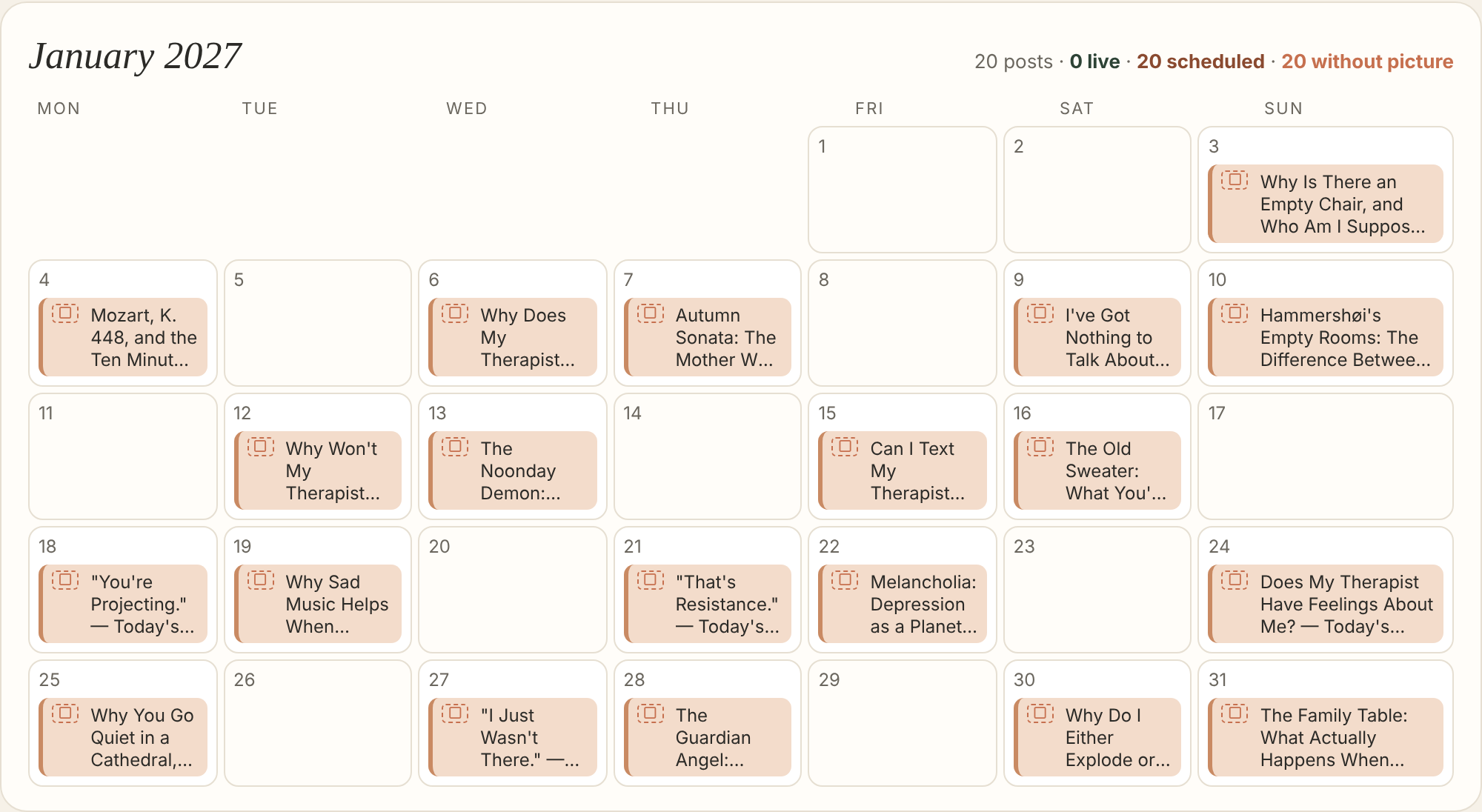
Control Room calendar: a month with scheduled posts, each marked whether it has a picture

You know this feeling.

You have a blog. You have ideas. What you don't have is a reliable answer to three questions, so you keep opening tabs.

"Did it go out?"

Your planning board says Tuesday. Your site says nothing. You check, again, from your phone.

"Which ones have no picture?"

Somewhere there's a list. It is not where you are. Three posts went live with a grey placeholder.

"Can Google even find it?"

You published in October. It's December. Nobody knows, least of all Google.

One page that knows.

The control room reads your real posts and asks Google the real question. It's never a plan. It's always the truth, as of this morning.

A calendar that tells the truth

Every month at a glance: green means it went live, peach means it is waiting, a dashed square means it still needs a picture. Not what you planned — what actually happened.

A calendar that tells the truth

The pictures you still owe

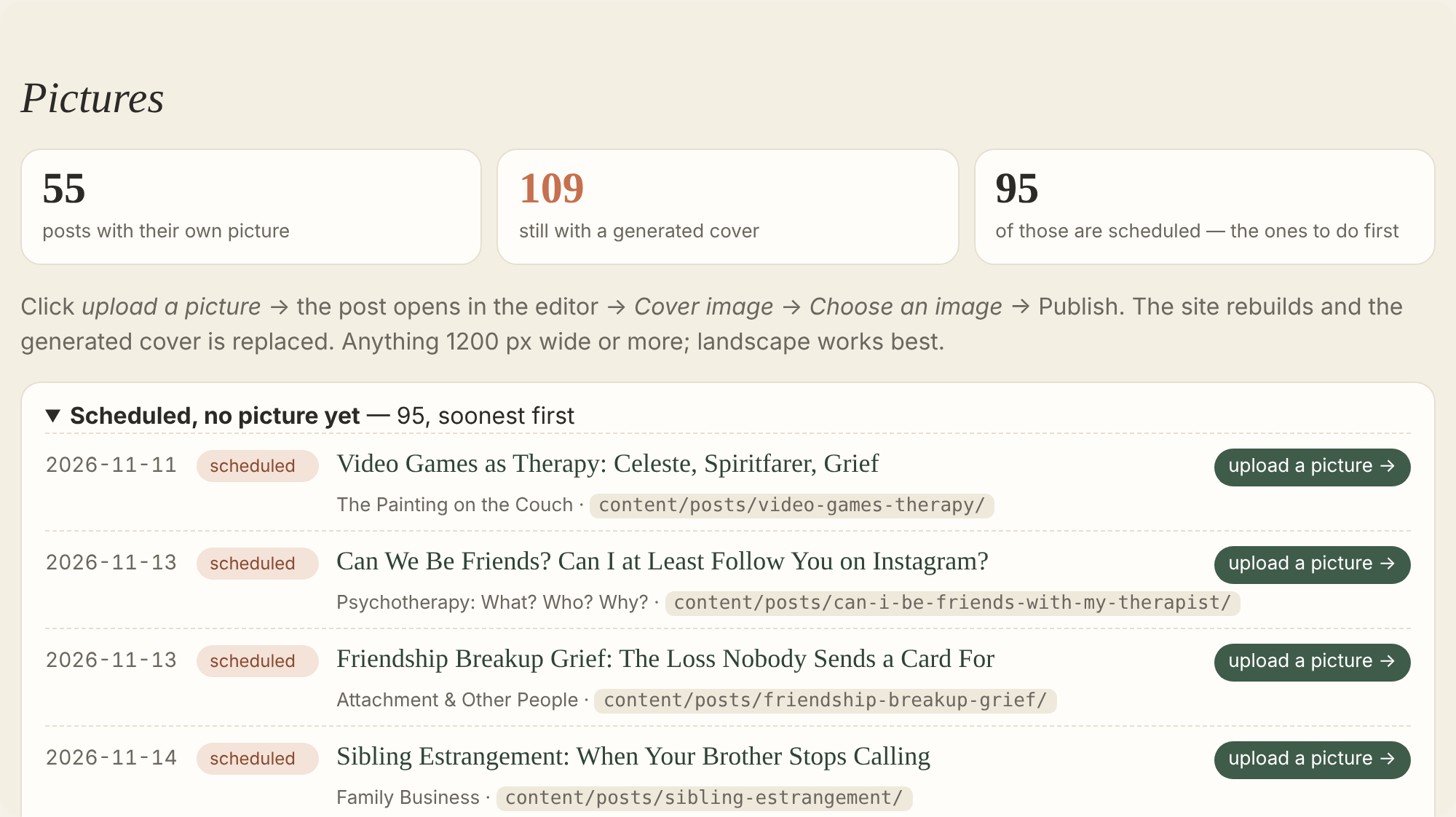
Scheduled posts with no picture, soonest first, each with one button that opens the right post in the editor. The job that always slips, made impossible to forget.

The pictures you still owe

Google, handled every morning

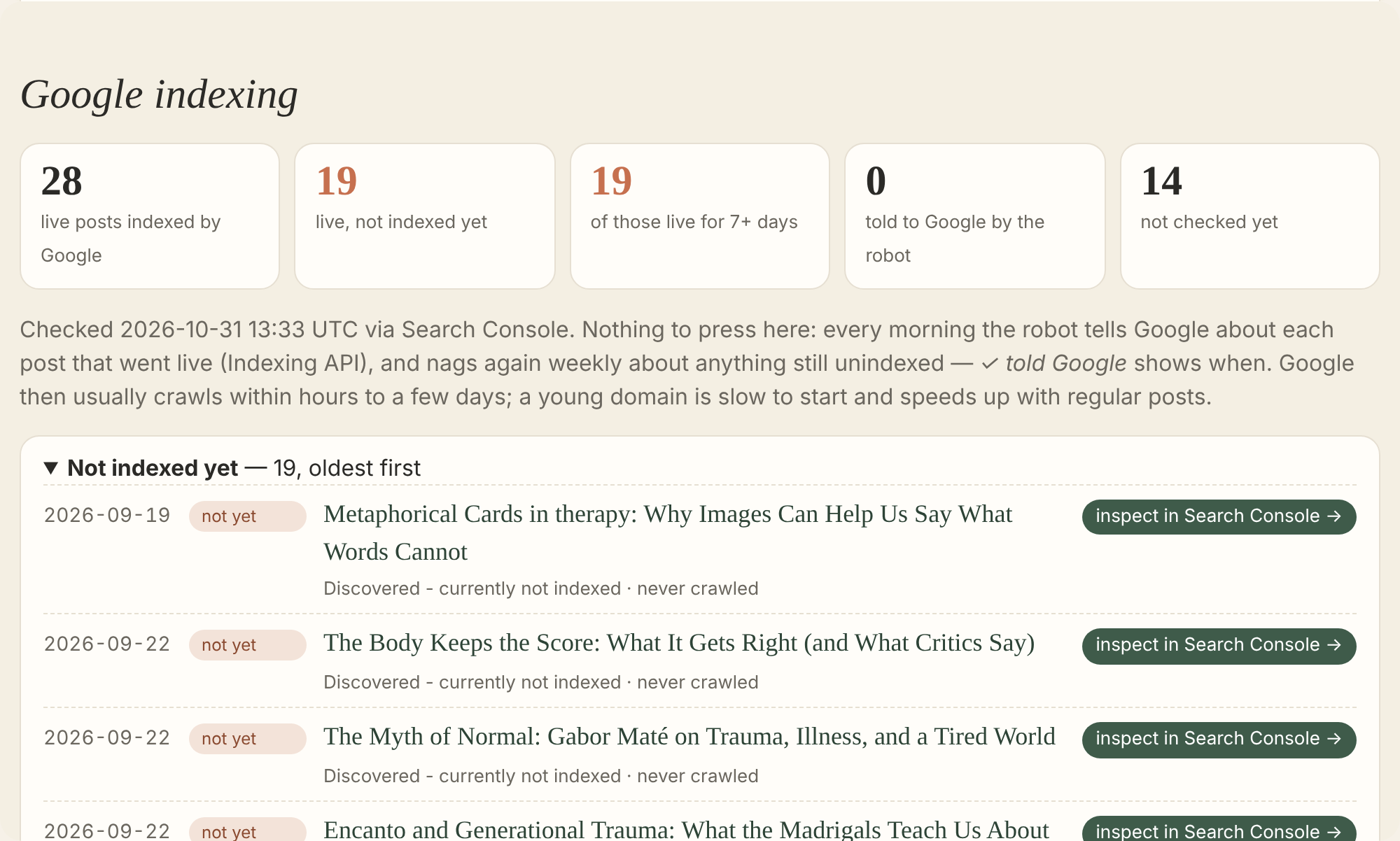
The robot asks Google whether each post is indexed and tells Google about the new ones. You see which posts the world can find and which it can't — and you never press "request indexing" again.

Google, handled every morning

The small things, checked

Posts without a column, tags nobody uses, a description that's too long for Google: a short list that is usually empty, and is loud when it isn't.

The small things, checked

How it works, honestly.

No magic. Four pieces that already exist, wired together so you never have to think about them.

Your posts are files

Each post is a folder with a text file and its pictures. No database to pay for, nothing that can be shut down. You own them like you own a document.

The date is the schedule

Put a date in the future and the post waits. On that morning, a robot rebuilds the site and the post is live. Two independent clocks, in case one oversleeps.

An editor that doesn't lie

Write in a clean editor in your browser. Filters show "published now", "scheduled", "no picture yet" — computed from the real files every morning.

Google, every morning

The robot asks Google whether each post is indexed and tells it about the new ones. You see the answer on the calendar as a small green dot.

Who made this, and why.

Tamar Mikava

I'm Tamar, a psychotherapist in Tbilisi. I write a blog that publishes a post every third day, in two languages, with a column for the questions people actually ask about therapy. I am not a developer, and I did not want a monthly bill for a content system that still couldn't tell me whether Tuesday's post had gone out.

So, with a lot of help, I built this for myself. The calendar was the moment it changed: for the first time I could see my whole blog in one place — what was live, what was waiting, which posts still needed a picture — and stop checking. A friend who teaches me these things saw it and said "other people need this." She was right, I think. If you write and you'd rather write than manage, this is for you.

— Tamar

Try it on your own posts. Free for a week.

A free week, then one price to own it, and an optional monthly plan for people who want a human watching. No card to start.