
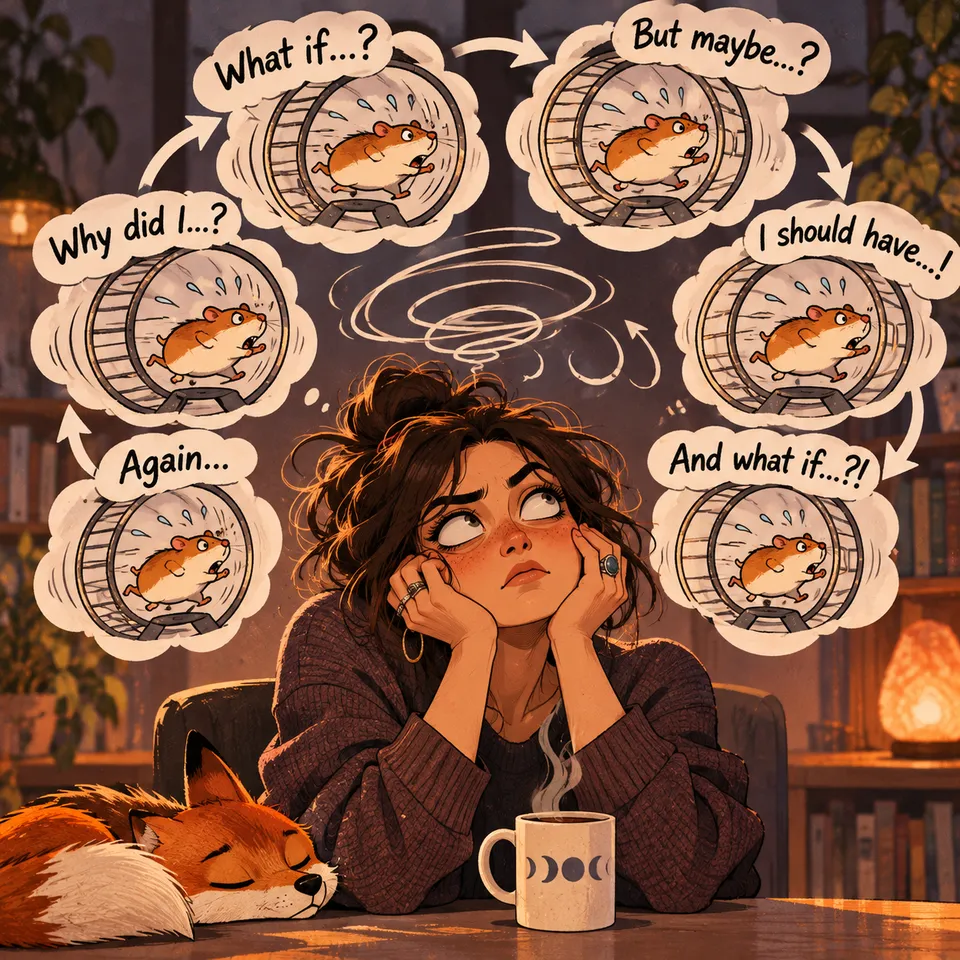
It is 2 a.m. and you are back in Tuesday's meeting, saying the thing you said, watching the face you watched. You have been here forty times. Nothing new has happened in any of them.
That is rumination. It feels like thinking, which is why it is so hard to put down. But thinking goes somewhere. This goes around.
What rumination is, and what it is not
Susan Nolen-Hoeksema spent her career on this. Her response styles theory, summarised with Wisco and Lyubomirsky in Perspectives on Psychological Science, defines rumination as repetitively focusing on your distress and its possible causes and consequences, without moving to action. Her research linked it to longer and deeper episodes of depression, and to anxiety.
The important distinction is between rumination and reflection. Reflection asks, what happened and what do I want to do? Rumination asks, why am I like this, why does this always happen, what is wrong with me? One question has an exit. The other is a hallway of mirrors.
If the question cannot be answered by anything you could do tomorrow, it is probably rumination.
Why does my brain keep replaying the same scene?
Edward Watkins at Exeter found something practical. In his review in Psychological Bulletin, the difference between helpful and unhelpful repetitive thought was not the topic. It was the level of abstraction.
Abstract processing sounds like: why do I always ruin things? Concrete processing sounds like: what exactly did I say, in what tone, and what happened in the thirty seconds after? The first is infinite. The second is finite, and finite things end.
Your brain replays the scene because it is trying to solve it. But it is solving at the wrong altitude. From 30,000 feet, every mistake looks like evidence of character. From ground level, it looks like a sentence you could phrase differently.
Groundhog Day is the best film about this, and not because of the repeated day. Phil Connors spends his first hundred loops asking abstract questions: why me, what is the point. The day only starts to change when he gets concrete. Learn the piano. Catch the kid falling from the tree at 3:40. The loop does not break through insight. It breaks through specifics.
Rumination lives in the abstract; the exit is in the detail.
What interrupts rumination
Three things have decent evidence, and none of them is "think about it more."
First, behavioural activation. Cuijpers and colleagues reviewed studies in Clinical Psychology Review and found that simply scheduling and doing activities, before you feel like it, was an effective treatment for depression. The body moves and the loop loses its audience.
Second, attention shifting. Nolen-Hoeksema's early experiments found that briefly distracting ruminators improved mood and problem-solving in the moment. Not as a lifestyle. As a circuit breaker. Eight minutes of something absorbing with your hands.
Third, writing, but a specific kind. James Pennebaker's work, collected in Opening Up by Writing It Down, suggests that expressive writing helps when it moves from venting toward making sense. Writing the same complaint fifty times is rumination with a pen. Writing what happened, then what you felt, then what you now understand, is something else.
The loop needs stillness, abstraction and privacy. Remove any one of them.
Is rumination always bad?
No, and this is where a lot of self-help gets smug. Watkins' point was that repetitive thought is a tool. Grief needs it. Decisions need it. Rehearsing a hard conversation is useful, once.
The problem is a tool that will not switch off. If you notice you have arrived at the same conclusion for the fifth time tonight, the thinking is finished. What remains is a nervous system that does not believe it yet.
You do not need a better answer; you need your body to accept the one you have.
Try this with a card
Metaphoric cards work on rumination because an image is stubbornly concrete. You cannot abstract your way around a picture of a boat.
- Draw. Hold the scene you keep replaying in mind and pull one card from the deck.
- Look. Describe the image out loud, only in sensory detail. Colours, textures, what is in the foreground. No meanings yet. This alone drags you down to ground level.
- Two questions. What in this picture is already over? And what is one small, physical thing the person in this picture could do in the next ten minutes?
Then do the thing, or its nearest real-world equivalent. Rumination does not survive contact with a kettle.
If the replays are nightly, if they come with hopelessness, or if you cannot remember the last day without them, that is a reason to talk to a professional rather than another reason to think harder.
Draw a card and give the scene somewhere else to go: psytamar.pro.