The clocks went back and so did you. Getting up feels like surfacing from deep water, and the plans you made in September seem to belong to a more energetic stranger.
Seasonal depression has a way of arriving disguised as a character flaw. It is not one. It is a body responding to light, or the lack of it, exactly as designed.
What is seasonal affective disorder?
The National Institute of Mental Health defines seasonal affective disorder as a type of depression that follows a recurring seasonal pattern, usually starting in late autumn and lifting in spring. It is not a separate illness in the manuals. It is major depression with a calendar.
The winter pattern brings a specific flavour: oversleeping, overeating with a pull toward carbohydrates, weight gain, and social withdrawal. Classic low mood, but hibernating rather than wired.
NIMH notes it is more common in women, in younger adults, in people living farther from the equator, and in those with a family history of depression or bipolar disorder. If you tick several boxes and live somewhere the sun sets before you leave work, your November is not a mystery.
If your mood has a date range, it is information, not indictment.
Why does November hit so hard?
Two systems are implicated, both run by light.
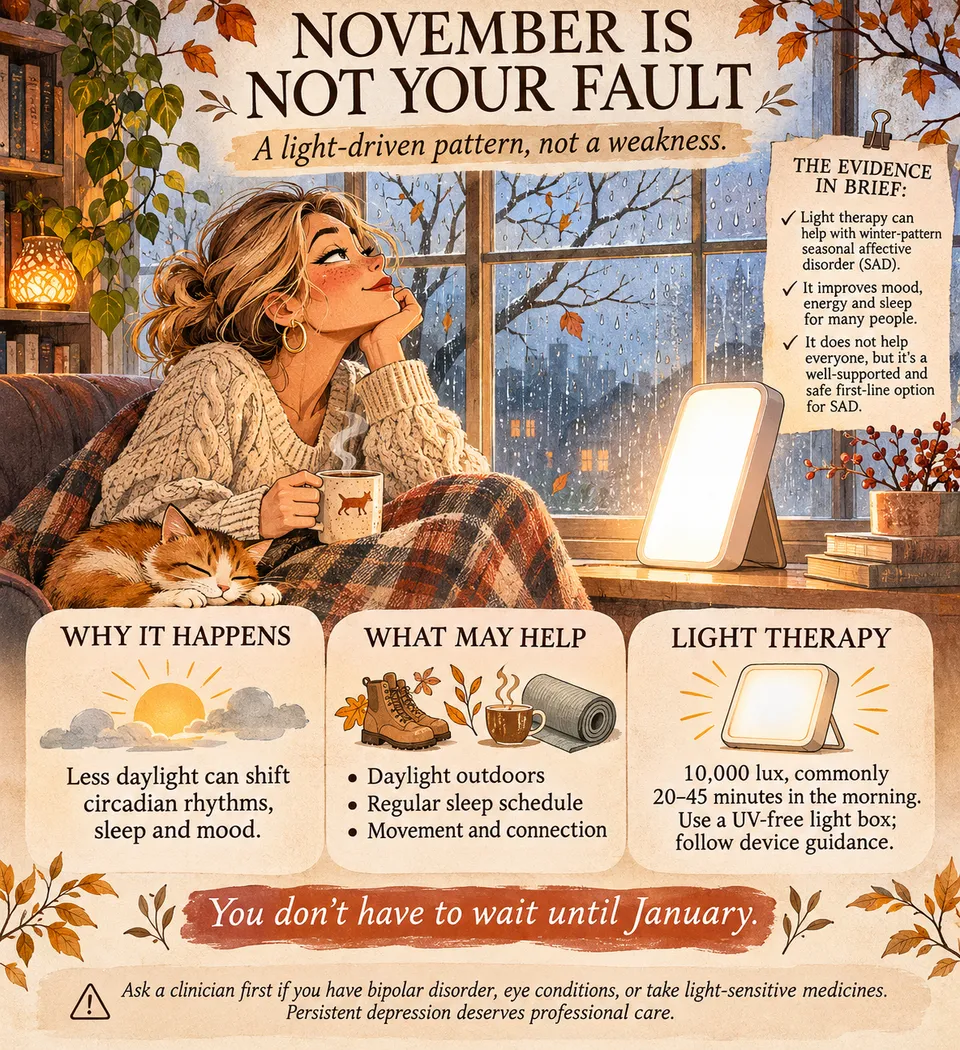
The first is your circadian clock. NIMH describes how reduced daylight can shift your internal timing so that the body's night runs longer than the actual night. You are, in effect, jet-lagged in your own kitchen. Melatonin, the hormone of darkness, is produced in larger amounts in people with winter-pattern depression, which fits the oversleeping.
The second is serotonin. Sunlight helps regulate it, and NIMH reports that people with SAD may have trouble keeping serotonin levels steady in winter. Less light, less regulation, lower floor.
The Holdovers understands this body knowledge without ever saying so. Everyone left behind at that New England school in December is moving at half-speed, eating badly, snapping over nothing. The film does not pathologise them. It turns the lights down and lets you feel what that does to three people who would rather be anywhere else. Warmth, when it comes, is a lamp in a kitchen and someone staying at the table.
Your winter body is not lazy; it is reading the sky and acting accordingly.
Does light therapy actually work?
Mostly yes, with caveats worth knowing.
A 2020 meta-analysis of randomised trials in Psychotherapy and Psychosomatics found bright light therapy outperformed placebo for seasonal affective disorder. NIMH's practical guidance: a light box delivering about 10,000 lux, used for 30 to 45 minutes, first thing in the morning, from autumn until spring.
The caveats. A Cochrane review of light therapy for preventing SAD, started before symptoms appear, found the evidence limited and of low quality. And people with bipolar disorder or eye conditions should check with a doctor before buying a box.
Light is not the only tool. NIMH also lists psychotherapy adapted for SAD, antidepressant medication and, with weaker evidence, vitamin D.
Light therapy is a treatment, not a mood lamp; use it like a prescription.
What to do before January
The useful move is to treat November as the start, not the middle. NIMH suggests that people with a known pattern may benefit from beginning treatment before symptoms set in. That is now.
Some small, unglamorous things: get outside within an hour of waking, even under cloud, because daylight through cloud beats any ceiling bulb for setting the clock. Keep a steady wake time, weekends included. Book the things you will not feel like doing, and treat the booking as the decision.
And look at the shape of your week. The Pentagram on this site shows which of your five areas has gone dark along with the sky. Usually it is body and people. One small act in each is often enough to stop the slide becoming a season.
You do not need to beat winter; you need to stop it making every decision for you.
Try this with a card
Metaphoric cards work well in low light because they ask for looking, not performing.
- Draw. In the morning, with your coffee and whatever daylight you have, pull one card from the deck.
- Look. Notice where the light is in the image. Where it falls, where it does not, what is half-seen.
- Two questions. What in my life is in the lit part of this card right now? And what is one thing I could carry from the dark part into the light today, not fix, just carry?
Keep the card where you will see it until the sun goes down. It is a small lamp, but it is yours.
If your low mood lasts most of the day for more than two weeks, or you have thoughts of not wanting to be here, please talk to a doctor or therapist now rather than waiting for spring to do it for you.
Draw a card and find out what still has light in it: psytamar.pro.