
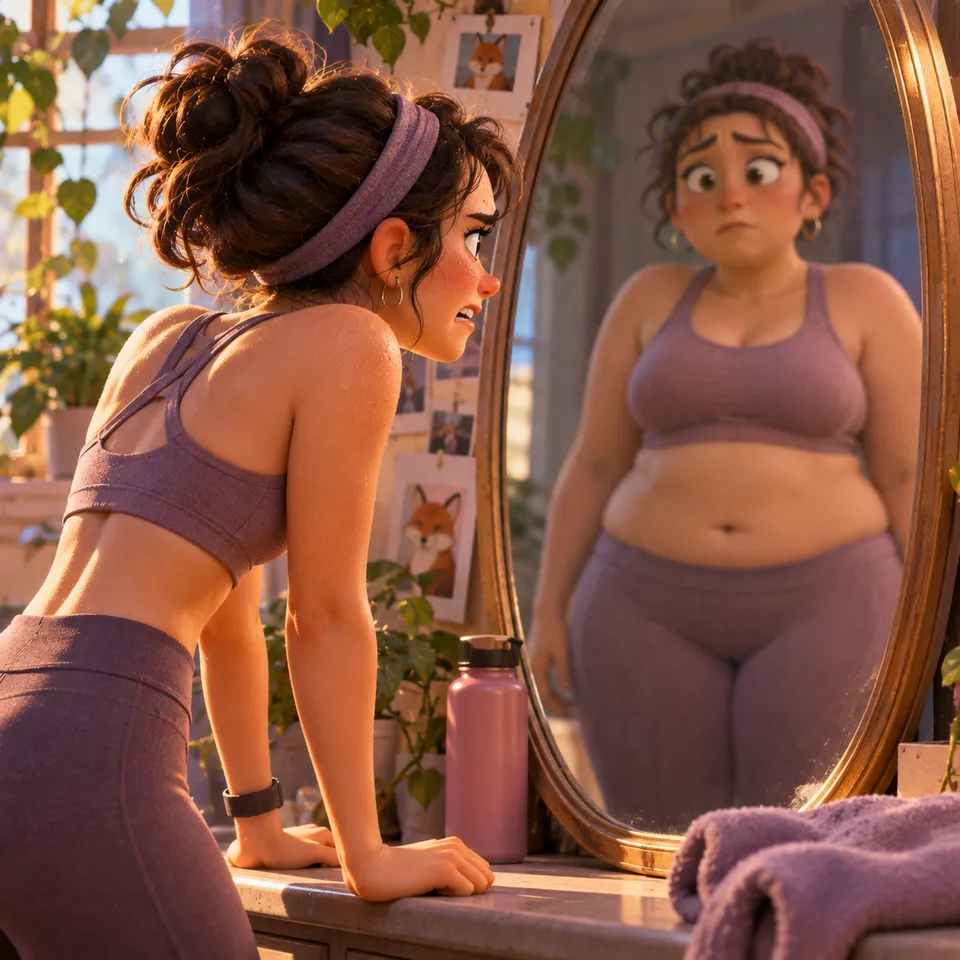
You pass a shop window and check. You stand in the bathroom and check again, from the angle that is worse, to be sure. The checking does not settle anything. It just books the next appointment.
Body image is one of those phrases that sounds like it means your body. It does not. It means the picture, the attitudes and the running commentary you carry about your body, which is a different thing altogether, and a far more negotiable one.
What body image actually is
Thomas Cash, who spent a career on this, defined body image in his handbook on the subject as a multidimensional thing: how you perceive your body, what you believe about it, how you feel about it, and what you do because of all that. Four strands, and only the first one is about what you see. The rest is history, mood and habit.
This is good news hiding in jargon. If body image were a reflection, you could only change it by changing the body. Since it is mostly a relationship, you can work on the relationship.
You do not have a body image problem. You have a relationship with your body that has gone cold.
Why does the mirror feel like a judge?
Because you rarely look at it alone. Mirrors come with an audience you have imported: the people you compared yourself to that morning, mostly on a screen.
Fardouly and colleagues, publishing in the journal Body Image, had young women browse Facebook, a magazine site or a neutral site, then measured mood and body concerns. Brief social media use lowered mood, and for women already prone to comparing, it increased worries about face, hair and skin. Not thighs or stomach: the specific features that appear in a profile photo. The platform shapes what you find wrong with yourself.
This is social comparison at industrial speed. You are not comparing yourself with people. You are comparing yourself with the best frame of the best day of thousands of people, and losing, as designed.
The mirror is not showing you your body. It is showing you the comparison you brought into the room.
Darren Aronofsky's Black Swan is practically a two-hour essay on this. Nina rehearses in rooms made of mirrors, and the film keeps letting the reflection move a half-second out of step with her. What she is looking for is not a flaw to fix; it is permission to be good enough from an image that will never grant it. Her mother's drawings, her rival's ease, the director's gaze: the mirror has become a committee. What the film understands is that the body itself is doing fine. It is dancing beautifully. It is the watching that is tearing her apart.
When looking becomes a disorder
For some people the checking crosses into body dysmorphic disorder, where hours a day go to worrying about a flaw others cannot see, with compulsive mirror checking or total mirror avoidance, heavy camouflage, and real damage to work and relationships. The NHS lists cognitive behavioural therapy, sometimes with SSRI medication, as the treatment, and notes that BDD is treatable. If this sounds less like a bad day and more like your life, that is worth a conversation with a GP.
From looking to sensing
Here is the body-oriented move, and it is simple. Looking puts you outside your body, in the seat of the judge. Sensing puts you back inside it, where the body is not an image but an experience: weight, breath, warmth, tiredness, hunger, the pull of a tight shoulder.
You cannot be in both seats at once. Every minute spent sensing is a minute the committee has no chair.
Try it now. Feet on the floor. Notice the floor pressing back. Notice the temperature of your hands. Notice where breath moves and where it does not. Nothing about this is an opinion. Nothing about this is a photograph. If a feeling surfaces that you cannot name, the emotion map is there for that.
Your body is not a view. It is a place, and you are allowed to live in it.
Try this with a card
- Draw one metaphoric card, or draw one here, after you have spent one minute sensing, not before. Let the body choose.
- Look at the card the way you wish you could look at yourself: with curiosity, no corrections. Where does your eye rest? What is the texture of the image?
- Ask two questions. What in this card is alive rather than attractive? Then: If my body could pick one thing from this image to say to me, what would it be?
Keep the card somewhere you will see it before the mirror does.
If body worry is shaping what you eat, where you go, or how much of the day you spend checking, a therapist, ideally one who works with the body as well as the thoughts, can help you change seats.
Before the next mirror, draw a card and look at something that is not looking back.