You are forty-something, maybe fifty, and something has shifted. You cry at adverts. You snap at people you love. You walk into a room and forget why, then feel unreasonably frightened by that. Your periods are still mostly here, so nobody has said the word yet.
The word is perimenopause. And the part nobody mentions is that menopause and mood are tangled long before the hot flushes arrive.
Why does perimenopause affect mood?
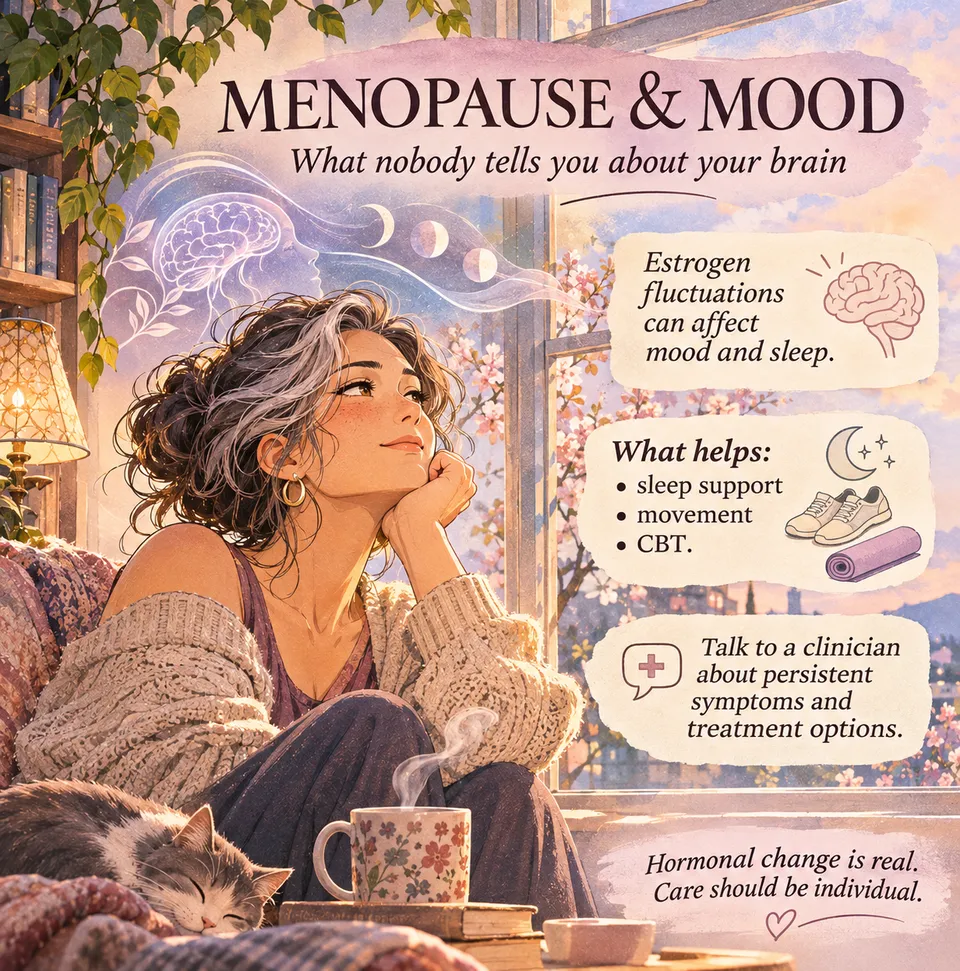
Oestrogen is not only a reproductive hormone. It is a brain hormone. It helps regulate serotonin, dopamine, sleep, temperature and the way your brain uses energy. In perimenopause, oestrogen does not politely decline. It lurches, high one week and low the next, and your brain has to keep recalibrating.
A 2024 meta-analysis from University College London, published in the Journal of Affective Disorders, pooled data on more than nine thousand women and found that perimenopausal women had roughly a 40 percent higher risk of depressive symptoms than premenopausal women. Interestingly, postmenopausal women did not show the same elevated risk.
The fluctuation, not the absence, seems to be the hard part.
That matters because it reframes what you are living through. This is not a character flaw or a sign you have stopped coping. It is a brain adjusting to a moving target, and that adjustment usually settles.
The brain is actually working hard
Neuroscientist Lisa Mosconi, author of The Menopause Brain, has spent years imaging what happens inside women's heads during this transition. In a 2024 study in Scientific Reports, her team at Weill Cornell used PET scans to measure oestrogen receptor density. As oestrogen fell, the brain grew more receptors, as if putting out extra nets to catch whatever hormone was left. Higher receptor density in mood and memory regions tracked with depressive symptoms and lower scores on thinking tests.
So the brain fog is real. The misplaced words, the lost thread mid-sentence, the sense of thinking through porridge. It is not early dementia, and it is not you getting stupid. It is a brain in renovation.
Your brain is not failing. It is compensating, loudly.
There is a scene early in Grace and Frankie where two women in their seventies discover their husbands are leaving them for each other, and the camera lingers on the strange freedom that follows the humiliation. What the show does well across seven seasons is refuse to treat older women's bodies as a punchline or a tragedy. Grace drinks, Frankie paints, both of them keep wanting things. The series is not about menopause, but it is about the same question menopause asks: who are you when the body you negotiated with for decades changes the terms?
What actually helps?
This is not a medical-advice piece, but you deserve to know the landscape.
Hormone replacement therapy. The Menopause Society states that hormone therapy remains the most effective treatment for hot flushes and night sweats. Whether it helps mood directly is a live research question, and the answer depends on your history, your age and the stage you are at. That conversation belongs with a doctor who knows menopause.
Talking therapy. The updated NICE guideline NG23 now recommends cognitive behavioural therapy as an option alongside or instead of HRT, for hot flushes, sleep problems and low mood linked to menopause. That is a British health body saying, in effect, that your mind is a legitimate place to start.
You do not have to pick one door; many women walk through several.
Sleep, movement, and alcohol are the unglamorous levers. Night sweats wreck sleep, bad sleep wrecks mood, and alcohol makes both worse. None of that is news. What is news is giving yourself permission to take it seriously now rather than once everything has collapsed.
Try this with a card
Perimenopause scrambles the signal between body and feeling. A metaphoric card can help you hear what is underneath the irritation.
- Draw a card without looking for a "right" one. Set it in front of you.
- Look at it for a full minute. Notice where your eye lands first and what your body does: tightening, softening, sighing.
- Ask two questions. What in this picture is changing? And: What in it is staying? Write a sentence for each.
The mood swings of midlife often hide a real grief and a real wish side by side. The card gives both a place to sit. If you want to go further, the Emotion map can help you name what showed up.
Naming the feeling is not fixing it, but it is the first thing that stops the spin.
When to talk to someone
If low mood lasts more than two weeks, if anxiety is stopping you from doing ordinary things, or if you have any thoughts of not wanting to be here, please speak to a GP or a therapist who understands menopause; this is treatable and you should not white-knuckle it.
And for today, you could simply draw a card and see what your brain, mid-renovation, has to say.