
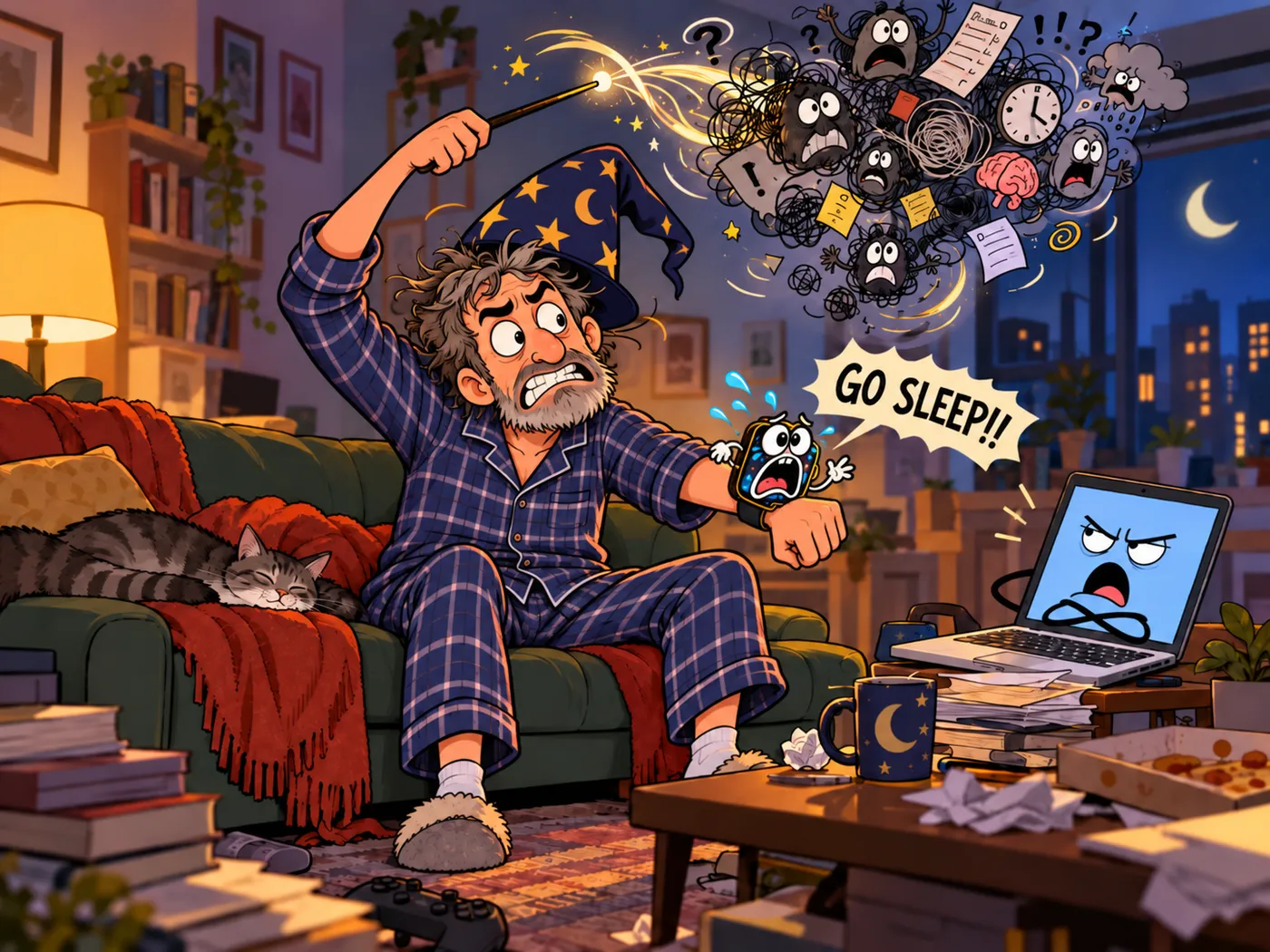
It is 3:12 a.m. You are awake, and the thing you handled fine at lunch has grown teeth. The email, the lump, the thing you said in 2014. By daylight it will shrink back. Right now it is the only true thing in the room.
Sleep and anxiety are not two problems that happen to share a bed. They feed each other, and the 3 a.m. version of your mind is not a more honest one. It is a tired one.
What sleep loss does to an anxious brain
In a well-known experiment, Yoo, Walker and colleagues kept healthy people awake for a night and then showed them unpleasant images in a scanner. The amygdala, the brain's alarm bell, fired far harder than in rested people. More telling: the link between the amygdala and the prefrontal cortex, the part that says hold on, let's think, had weakened.
That is the whole story of 3 a.m. in one picture. The alarm is louder and the hand that usually turns it down has gone quiet.
A sleep-deprived brain does not see more clearly. It sees more alarmingly.
Why do thoughts feel truer at night?
Partly biology, as above. Partly circumstance. At night there is nothing to compare your thought against. No colleague saying "that's not what I meant", no sunlight, no dog needing a walk. A thought with no competition starts to look like a verdict.
There is also the loop. A systematic review in the journal Sleep found the relationship between insomnia and anxiety runs in both directions: poor sleep raises later anxiety, and anxiety raises later poor sleep. So the worry that keeps you up is partly a product of being kept up. It is a closed circuit, and you are standing inside it, mistaking the hum for information.
Satoshi Kon's Paprika understands this better than most films about dreaming. When the device that lets therapists enter dreams is stolen, the dream world does not stay politely in its lane. It leaks into daylight. A detective's unresolved guilt walks down a real corridor. The film's parade of refrigerators and dolls is funny until you realize it is the texture of a mind with no border between inside and outside. That is also a fair description of 3 a.m.: the border guard is asleep, even if you are not.
Night thoughts are not lies exactly. They are dreams that have not had the decency to wait for you to fall asleep.
What actually helps: CBT-I, not just "sleep hygiene"
Camomile tea is fine. But the American Academy of Sleep Medicine makes one strong recommendation for chronic insomnia, and it is not a tea. It is cognitive behavioural therapy for insomnia, CBT-I: a short, structured treatment that works on your thoughts about sleep and the habits that tie the bed to wakefulness.
Some of its ideas you can borrow tonight:
- If you have been awake for what feels like twenty minutes, get up. Sit somewhere dim. Return when sleepy. The bed should mean sleep, not debate.
- Keep the same wake time every day, including after a bad night. This is unpopular advice and it works.
- Write the worry down, in one plain sentence, on paper. Then write when you will deal with it. Tomorrow at ten is an answer. Now is not.
You cannot argue a tired brain into calm, but you can stop teaching it that the bed is where arguments happen.
Try this with a card
If you lie awake with the same loop, keep a deck of metaphoric cards by the bed, or use the digital one.
- Draw one card, without choosing. Look at it in low light.
- Look for a full minute. Not for meaning. Just notice what is in the image, where your eye goes, what the body does as you look.
- Ask two questions. What in this picture is awake, and what is resting? Then: If the 3 a.m. thought were a figure in this card, how far away would it be standing?
You are not interpreting. You are giving the alarm a different object to look at, and letting the quiet part of the brain back into the room. If the card shows something unexpectedly gentle, let it. Even the amygdala likes a picture.
A simple wind-down, no gadgets
An hour before bed, dim the lights. Half an hour before, put the phone in another room. Ten minutes before, do something boring with your hands. In bed, notice the weight of your legs, then your back, then your head. Count breaths to ten and start again. When the thought arrives, and it will, say noted and return to the count. It is not a cure. It is practice in not following.
If sleepless nights have become most nights, or the anxiety stays through the day, a GP or a therapist trained in CBT-I can help, and you do not need to be at breaking point to ask.
Tonight, before the loop begins, draw a card and let something else have the floor.