
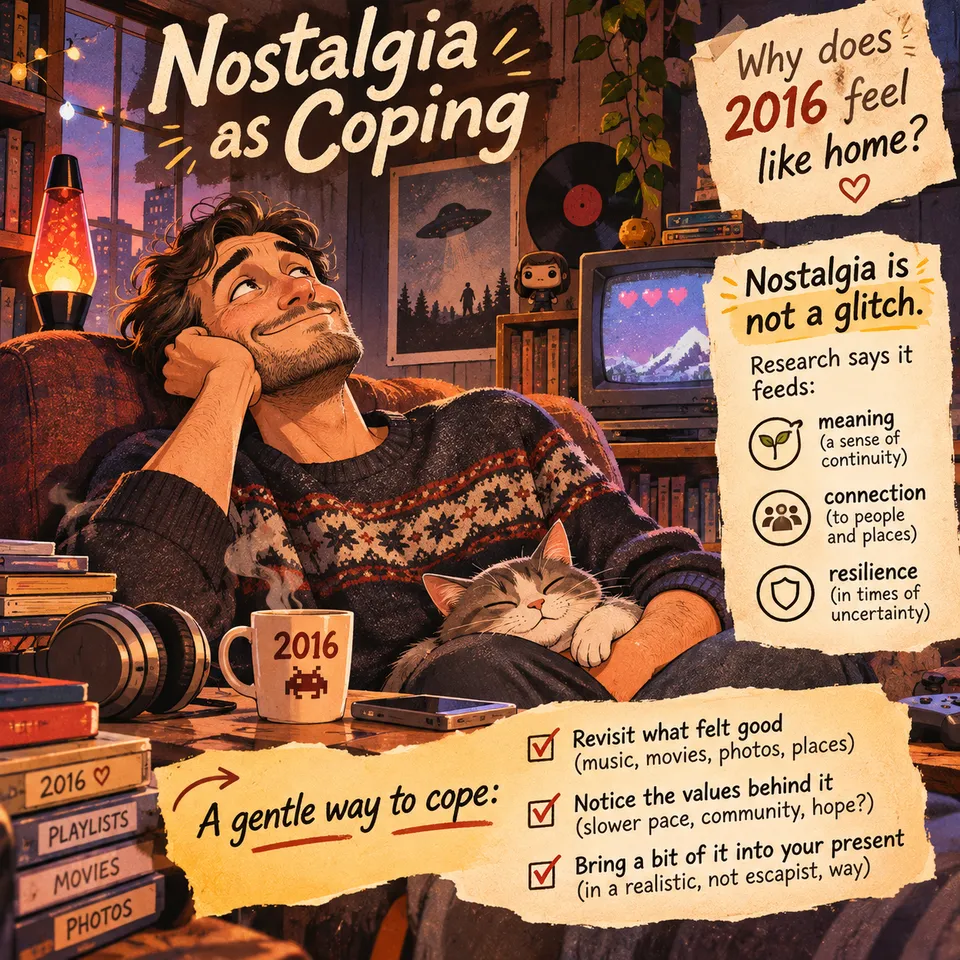
You put on a playlist from a decade ago and something in your chest unclenches. You rewatch a show you have already seen four times. You scroll old photos at midnight and feel, for a moment, like a person who knows where she lives.
Then you wonder if this is a problem.
Nostalgia as coping has a bad reputation. It sounds like refusing to grow up, or like the first step towards buying a vintage Walkman. But the research tells a more interesting story, and it is mostly on your side.
What nostalgia actually does for you
For most of its history, nostalgia was treated as an illness. Swiss doctors once thought it was a brain disease of homesick soldiers.
Then Constantine Sedikides and Tim Wildschut at the University of Southampton started asking people what nostalgia actually felt like. Their 2008 review found it was a mostly positive, social emotion: it lifts mood, raises self-esteem, strengthens the sense of being connected to others, and softens existential dread.
A later paper by the same group framed nostalgia as a psychological resource: something you reach for when meaning runs low, and that tends to give it back.
Nostalgia is not you looking backwards. It is you reminding yourself who you are.
Why does 2016 feel like home?
Notice what your nostalgic memories have in common. They are rarely about things. They are about rooms full of people, a specific kitchen, the walk home from somewhere.
Nostalgia is built from social scenes with you in the middle of them. That is why it works when you feel lonely or unmoored: it replays evidence that you were once held by a world. The year itself is almost incidental. "2016" is shorthand for "the last time life felt like it had edges."
This is also why Stranger Things landed so hard. The show is set in the eighties, but it is not really about the eighties. It is about a town where kids ride bikes in packs and adults, eventually, show up. Watching it, you are not missing synths and Eggo waffles. You are missing a feeling of belonging that you may never have had, which is the strangest and most common kind of nostalgia there is.
The era you long for is usually a feeling wearing a costume.
When nostalgia turns into avoidance
Nostalgia helps most people most of the time. Not everyone, not always.
A study from the University of Bath found that for habitual worriers, nostalgia could backfire, increasing anxiety and low mood rather than easing them. If your mind tends to loop, the past can become one more thing to compare the present against and lose.
There are a few signs it has tipped over. You visit the past to feel better but come back feeling worse. The rewatching has become a way to avoid an unopened email, a conversation, a decision. You are hiding from now.
The difference is direction. Healthy nostalgia is a round trip. You go back, collect something, and return to today with a slightly fuller tank. Avoidant nostalgia is a one-way ticket you keep renewing.
If the past makes today feel smaller instead of warmer, it has stopped being a resource.
Collective nostalgia and the "we" you miss
Sometimes the longing is not personal at all. It is for a group: the friends from your first job, the country you left, an internet that felt like a village.
Wildschut and colleagues call this collective nostalgia, and it has its own effects. Remembering "how we were" increases loyalty to the group and willingness to act for it. That can be lovely. It can also be weaponised, as anyone who has seen a political slogan about the good old days will know.
So when you feel it, ask: whose "we" am I missing, and what would it take to build a small version of it now? On the emotion map, longing often sits right next to something you want and have not asked for.
Try this with a card
Nostalgia is already a metaphor your mind made. A card just makes it visible.
- Draw. Pull one card while thinking of the time you miss. Do not choose; take what comes.
- Look. Spend a minute noticing what in the image feels like "then." A colour, a figure, a doorway. Let it be literal or odd.
- Two questions. Ask the card: What was I getting back then that I need now? Then: Where in my life this week is a small version of that already waiting? Write the answers without editing.
You are not trying to go back. You are trying to find out what to bring forward.
If the past has become the only place you can breathe, or looking back regularly leaves you flat for days, that is worth bringing to a therapist rather than carrying alone.
Otherwise, light the lamp, pick a song, and draw a card. The eighties kids would approve.