
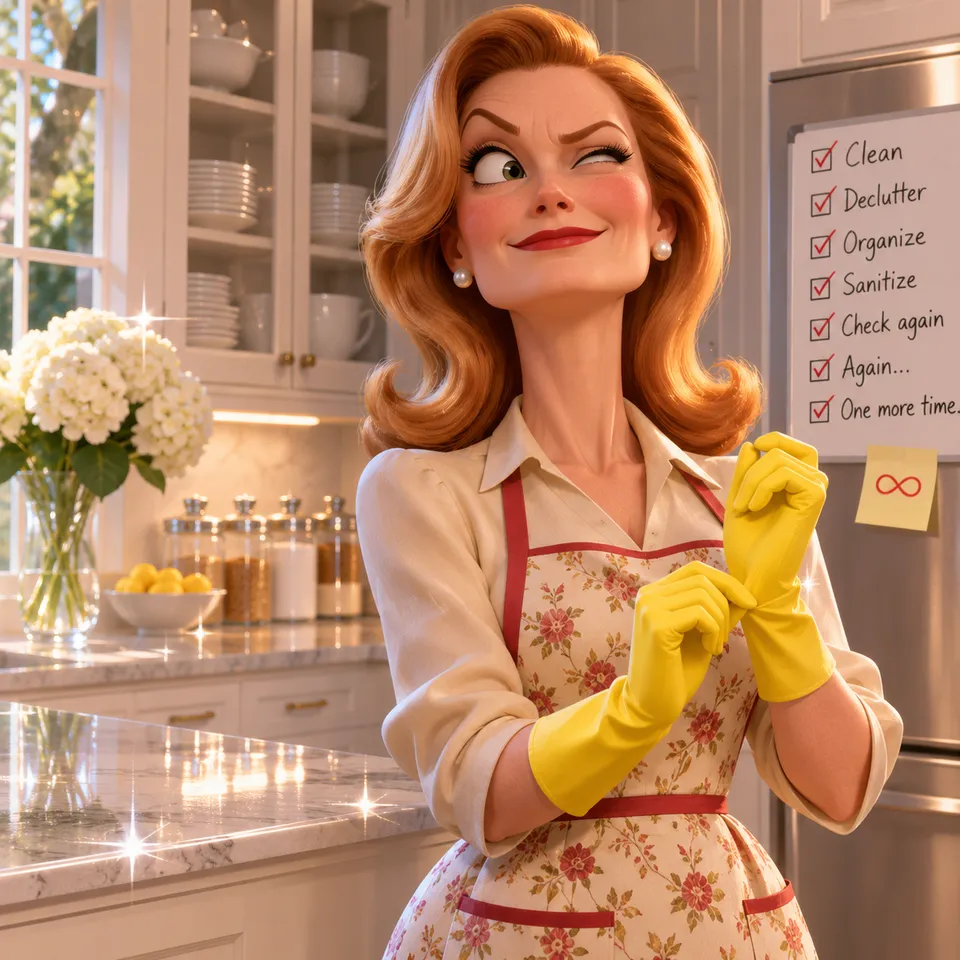
You said something slightly unkind in 2019 and you still check, most weeks, whether you are a bad person. You apologise for things nobody noticed. You replay a conversation to make sure you did not lie by accident.
People call you conscientious. It does not feel like a compliment. It feels like a court that never adjourns.
What is scrupulosity?
The International OCD Foundation describes scrupulosity as a form of OCD built around religious or moral obsessions. The content is sin, harm, honesty, purity, blasphemy, fairness. The structure is identical to every other OCD: an intrusive doubt, a spike of dread, and a compulsion to make the dread go away.
The compulsions are just quieter. Instead of hand-washing, you confess. Instead of checking the stove, you mentally review the day for wrongdoing. You ask a friend, again, whether that thing you said was okay.
The IOCDF notes that in more secular countries, a sizeable minority of people with OCD have scrupulous symptoms, and in strongly religious cultures it is the most common form. It is not fringe. It is just rarely named, because it looks so much like virtue.
Scrupulosity is not too much conscience; it is conscience hijacked by an anxiety disorder.
How is scrupulosity different from having principles?
This is the question people with it ask most, usually at 1 a.m. The answer is in the aftermath.
A principled person does a wrong thing, feels appropriate guilt, repairs what can be repaired, and moves on. The guilt is proportionate and it has an end date. A scrupulous person does a possibly-wrong thing, or imagines one, and the doubt does not resolve no matter how much evidence arrives. The question is not "did I do harm?" It is "can I be certain I did not?" And certainty is the one thing OCD never grants.
Chidi in The Good Place is the funniest portrait of this I know. He is a professor of moral philosophy who cannot choose a muffin. He is not indecisive because he lacks values. He has so many that every choice becomes a potential catastrophe. Watching him, you realise that his torment is not ethics. It is the demand to be sure, applied to a universe that does not do sure.
What makes the show kind is that nobody suggests he care less. The problem was never caring.
Integrity tolerates uncertainty; scrupulosity cannot.
Why does reassurance make it worse?
Because reassurance is a compulsion in someone else's mouth.
When you ask "was that okay?" and a friend says yes, the relief is real and lasts about as long as a hand-wash. The brain learns the lesson: that doubt was dangerous, and asking is how you survive it. Next time the doubt arrives louder, and the asking becomes more urgent. Jonathan Abramowitz lays this out in Getting Over OCD. Every answer feeds the question.
This is why loving partners of scrupulous people often become exhausted and confused. They are being asked to perform a ritual they did not sign up for, and the ritual never works for long.
The problem is not the doubt; it is the belief that the doubt must be answered.
What treatment actually works
Exposure and response prevention. The UK's NICE guideline recommends CBT including ERP as a first-line treatment for OCD, and the IOCDF lists it as the gold standard for scrupulosity specifically.
In practice, ERP for moral OCD looks strange from outside. You deliberately leave a small uncertainty unresolved. You do not confess the thing. You write "I might be a bad person and I will never know for sure" and sit with the sweat. Over weeks, the nervous system learns that uncertainty is uncomfortable, not fatal.
Religious clients often fear that therapy will strip their faith. Good clinicians, and the IOCDF, suggest working alongside a trusted faith leader to separate doctrine from disorder. Most traditions already have a word for this. Catholicism has used "scruples" for centuries, and not as praise.
Getting better does not mean caring less; it means letting a question stay open.
Try this with a card
Metaphoric cards suit scrupulosity because an image refuses to give you a verdict. That is the point.
- Draw. Think of the moral question you keep reopening and pull one card from the deck.
- Look. Notice your urge to decide what the image "means" and whether it is good or bad. Let the urge be there. Describe the picture without judging a single thing in it.
- Two questions. If I never got an answer to my question, what would I do with the next hour? And where on the emotion map does the unanswered question sit right now?
Do not check your answer afterwards. That is the exercise.
If moral checking takes more than an hour of your day, or has you avoiding people, places or prayer, a therapist who knows ERP can help, and asking for that is not a compulsion.
Draw a card and practise not being sure: psytamar.pro.