
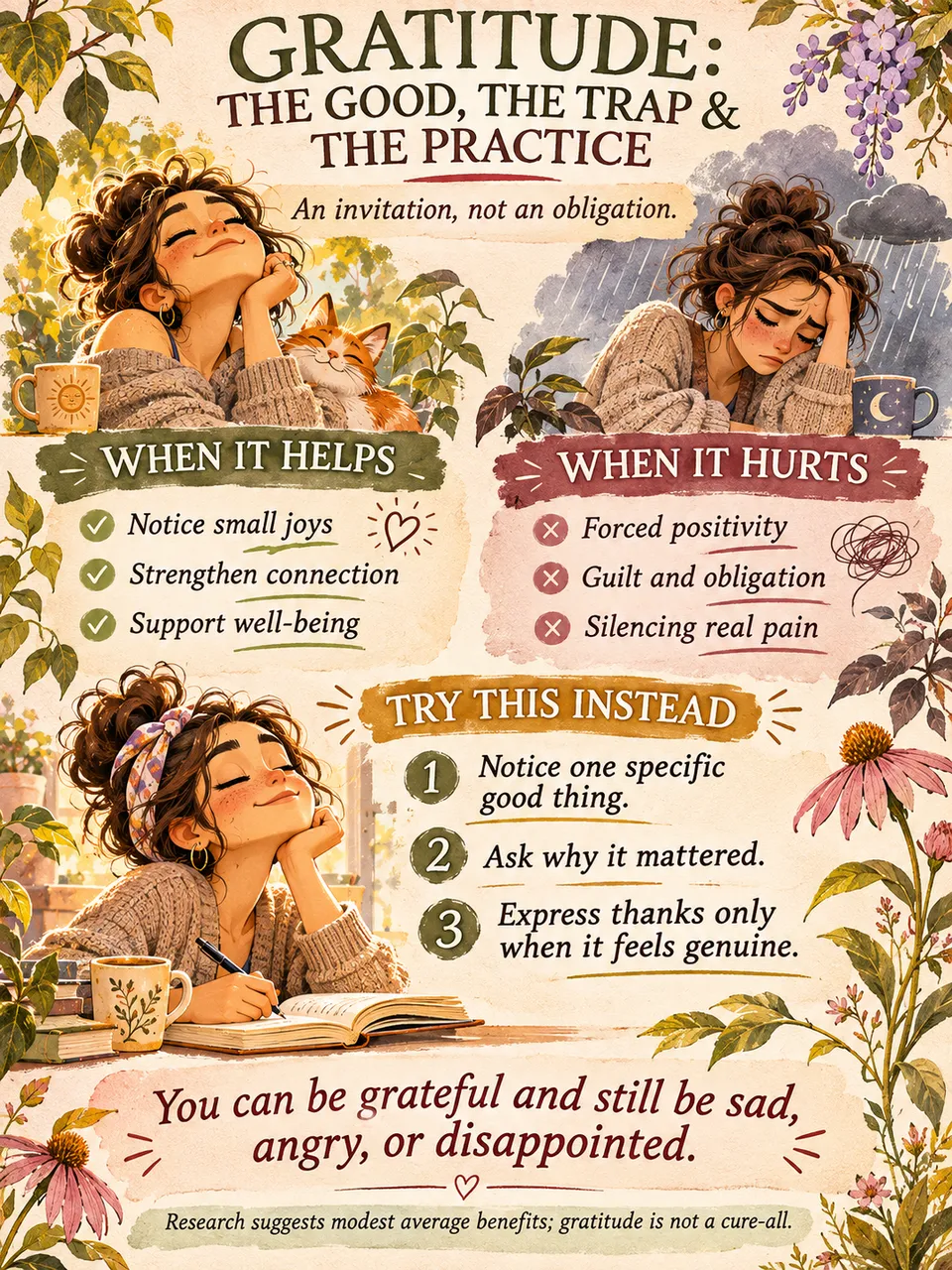
You have the notebook. You wrote "coffee, sunlight, my dog" three nights in a row and felt, if anything, slightly annoyed. Someone online promised this would rewire your brain. It has not, so far, rewired anything.
Gratitude research is a strange field: half of what people say about it is true, and the other half is a motivational poster. Let's separate them.
What the gratitude studies found
The paper that started the wave is Emmons and McCullough (2003). People who listed things they were grateful for each week reported better mood and more optimism than people listing hassles. It was a real finding, with a modest sample, and it has been cited roughly a million times by people selling notebooks.
Then came the meta-analyses, which is where things get sober. Davis and colleagues (2016) pooled the trials and found gratitude interventions worked better than doing nothing, but not clearly better than other mildly pleasant activities. Cregg and Cheavens (2021) looked at 27 studies with 3,675 people and found a small effect on depression and anxiety, g = −0.29. Their own conclusion was that if you are actually depressed or anxious, you should reach for something with stronger evidence.
Gratitude is a real, small lever, not a cure, and the research says so in plain language.
Can gratitude make you feel worse?
Yes, and you may have already felt the mechanism. If you are grieving, exhausted, or in a bad marriage, being told to "focus on the positive" lands as a correction. The message underneath is: your feeling is a mistake.
This is the toxic positivity risk. It is not that gratitude is harmful; it is that gratitude used as an eraser is. In gestalt terms, you are interrupting contact with a real emotion before it has finished. The emotion does not leave. It waits.
Gratitude works alongside difficult feelings, never instead of them.
If you want to check what is actually underneath before you reach for thankfulness, the emotion map is built for exactly that pause.
The man on the bridge
It's a Wonderful Life gets filed under "heartwarming", which misses how dark it is. George Bailey spends two hours furious. He gave up every plan he had for other people, and the film does not pretend that was free. His gratitude at the end is not a reframe. It is what remains after he has fully felt the loss of the life he did not get.
That is the version of gratitude the research quietly supports. George does not list "wife, kids, house" and feel better. He is shown, in painful detail, specific people whose lives are different because he exists. The gratitude is specific, it is about others, and it arrives after the grief, not instead of it.
Gratitude that holds up is about particular people and particular acts, not categories.
How do you practise gratitude so it actually works?
Three things show up across the better studies.
Be specific. "My sister drove forty minutes to sit with me" does more than "family". Vagueness is how gratitude journals go stale.
Do it less often. In Emmons and McCullough's work, weekly listing seemed to do more than daily. Novelty matters; a daily chore becomes a chore.
Point it outward. Writing or delivering a letter of thanks to a real person tends to outperform private listing. Gratitude is social at its root. It is a form of contact.
Specific, infrequent, and directed at someone: that is the recipe the data likes.
Try this with a card
Instead of a list, try one card.
- Draw a metaphoric card. Do not pick; let it be random.
- Look at it for a full minute. Notice what in the image your eye keeps returning to, and what you want to look away from.
- Ask two questions. First: Who does this remind me of, and what exactly did they do? Second: What did it cost them? Write both answers in two or three sentences, by hand if you can.
That second question is the one most gratitude practices skip, and cost is what turns "thanks" into something that moves you.
If your low mood has lasted more than a couple of weeks, or gratitude exercises leave you feeling more ashamed rather than less, that is worth bringing to a therapist rather than a notebook.
Otherwise, draw a card and see who shows up.