
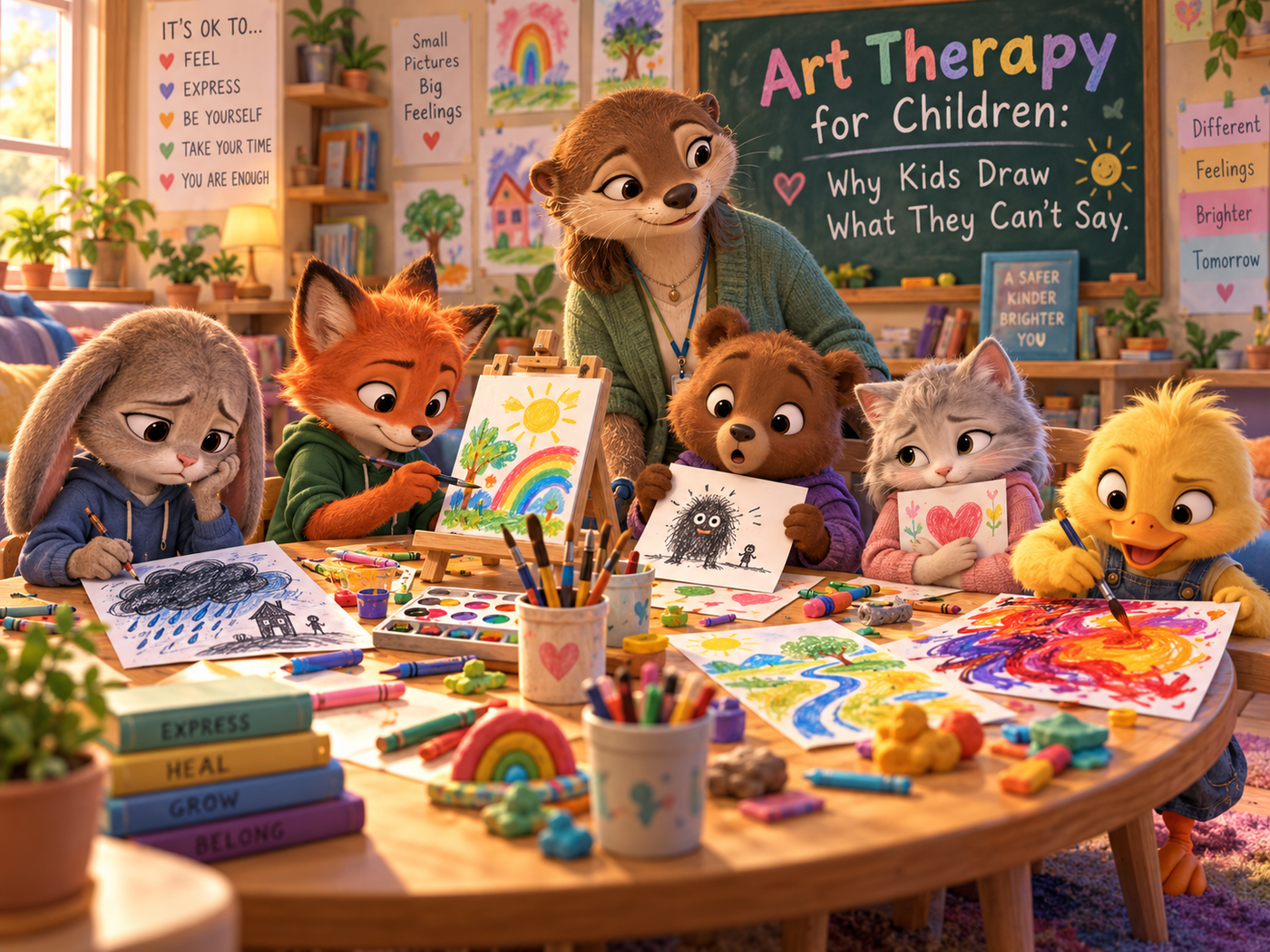
Your kid came home quiet, went to the table, and drew a house with no door. You asked what happened at school and got "nothing". The drawing says more than the mouth does, and you are not sure whether you are allowed to read it.
That gap is exactly where art therapy for children lives. Not because drawings are secret codes, but because for a small person a picture is easier than a sentence.
What is art therapy for children?
The American Art Therapy Association defines art therapy as a mental health profession that uses active art-making and creative process within a psychotherapeutic relationship. Note the last part. It is not a colouring book handed over by a stranger. It is a trained person, a child, materials, and a relationship that holds all three.
For adults, therapy mostly runs on talk. For children, talk is a second language they are still learning. Clay, crayons, paint and collage are the first one.
Art therapy with children is not about producing art; it is about having a safe place to make something, and someone who pays attention while you do.
Why do children draw before they can explain?
Viktor Lowenfeld, an art educator who spent a career watching children draw, laid out stages in Creative and Mental Growth: the scribble, then the first wobbly symbols (a circle with legs is a person), then the "schema" years when every house gets the same chimney, then the slow, self-conscious drift toward realism. Each stage is a child's current theory of the world, drawn out loud.
The point for a parent is simple. A drawing is a snapshot of where the child's thinking is, not a hidden message. A five-year-old draws mum bigger than the house because mum matters more than the house, not because of a measuring error.
Feelings arrive in the body long before the words for them do. That is why the Emotion map on this site asks you to paint where a feeling sits rather than name it. Children do this naturally; adults have to be reminded.
Drawing is the child's native tongue for feeling; words are the translation, and translation comes later.
What does an art therapist actually do?
Mostly: less than you would think, and more carefully.
Cathy Malchiodi, whose Understanding Children's Drawings is a standard text, keeps returning to one idea: process over product. The therapist watches how the child chooses the colour, whether she tears the paper, whether he hides the picture or shoves it at you. Then the therapist asks the child to tell the story of the picture. The child's story, not the adult's guess, is the data.
A good art therapist will not say "the black sky means grief". They will say "tell me about this sky". And then wait.
The therapist's main tool is not interpretation; it is a question, followed by silence.
What can a parent read into a drawing?
Here is the short list.
You can read: what the child chose to include, what they chose to leave out, how they felt while drawing (pressed hard, gave up, laughed), and what they say about it afterward. You can also read change over weeks. The same dog drawn ten times is a fact worth noticing.
You cannot read: a diagnosis. One dark drawing is a dark afternoon. Children use the closest colour, the sharpest pencil, and whatever they saw on a screen an hour ago.
Peter H. Reynolds' picture book The Dot gets this exactly right. Vashti says she cannot draw. Her teacher asks her to make a mark and sign it. The teacher does not analyse the dot; she frames it. The next day Vashti is making dozens. The whole story is about what happens when an adult takes a child's mark seriously without explaining it back to her.
The most useful thing you can do with a child's drawing is treat it as a beginning, not a verdict.
Try this with a card
You need a metaphoric card (draw one at the top of the home page) or the child's most recent drawing. Ten minutes, no agenda.
- Pick together. Let the child draw a card, or choose which of their own drawings to look at. Their choice, not yours.
- Look in silence first. Count to ten in your head. Children fill silence faster than adults do, and what they fill it with is the interesting part.
- Ask two questions, then stop. "What is happening here?" and "What happens next?" Do not add "why". Do not correct the story. If the answer is "nothing", say "okay" and leave the card on the table. It usually gets picked up again.
If a child's drawings change sharply and stay changed, or come with sleep, appetite or school troubles, that is the moment to talk with a child psychologist or registered art therapist rather than reading the pictures alone.
Not sure what is on your own mind tonight? Draw a card and see what you make of it.