Good news for everyone who stopped drawing at age nine because someone said their horse looked like a potato: that potato-horse may have been therapeutic. 🥔🐴
Art therapy isn't about making beautiful things. It's about making honest ones.
What is art therapy?
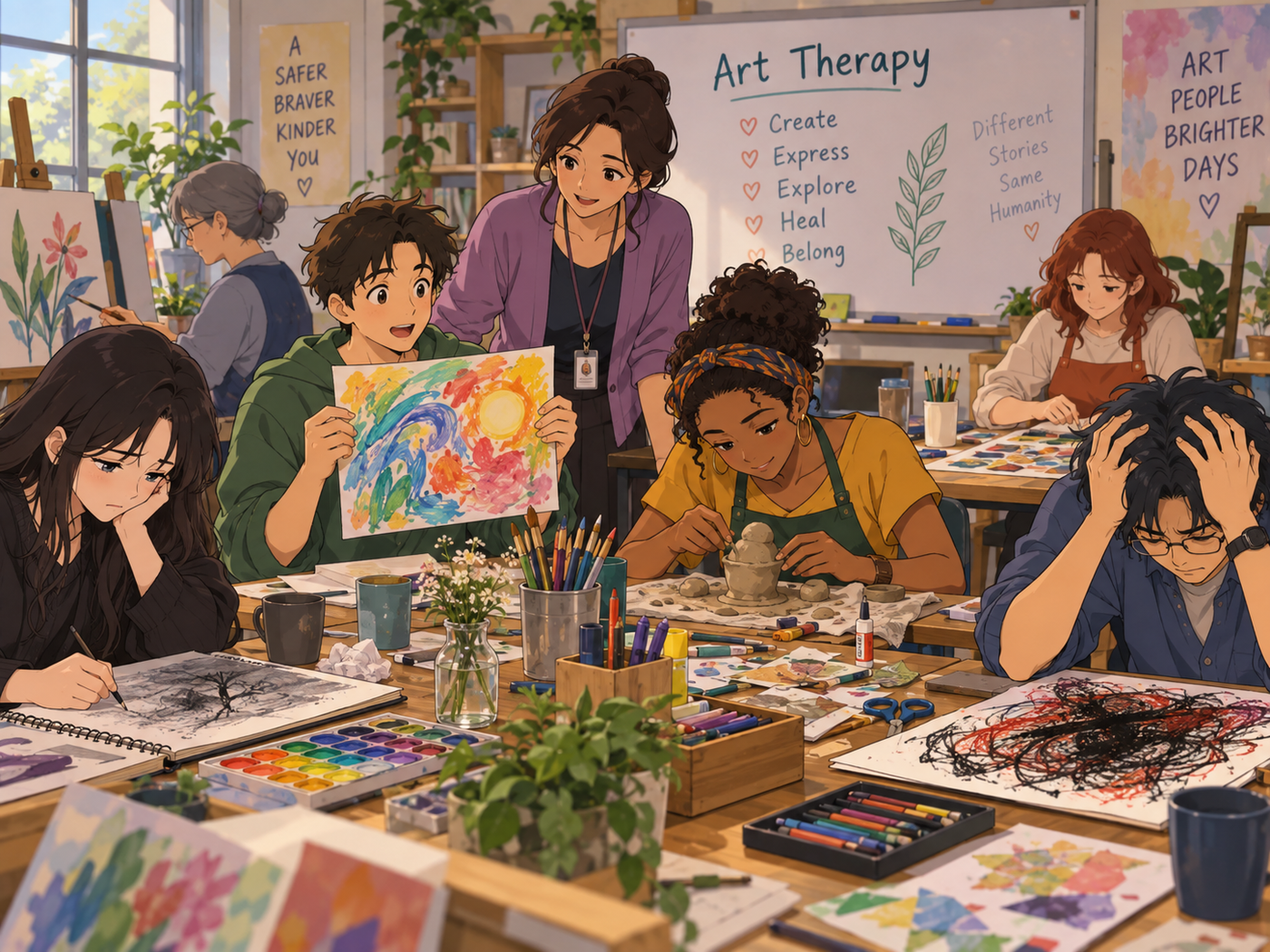
Art therapy is a form of therapy in which creating visual art, such as drawing, painting, collage, or clay, is used to explore feelings, process experiences, and support well-being, guided by a trained art therapist.
The term was coined in 1942 by British artist Adrian Hill, who discovered that painting helped him recover while he was being treated for tuberculosis in a sanatorium. Later pioneers, including Margaret Naumburg (often called the "mother of art therapy" in the United States) and Edith Kramer, helped shape it into a profession.
Making art vs. art therapy: both can help. Art therapy adds a trained professional, a safe relationship, and a clear purpose.
What the research says 📚
- A big-picture review from WHO. In 2019, researchers Daisy Fancourt and Saoirse Finn published a World Health Organization scoping review of more than 900 publications, covering over 3,000 studies. They found that the arts can play a role in preventing illness, promoting health, and managing and treating a range of conditions.
- Stress hormones. In a 2016 study, Girija Kaimal and colleagues asked 39 adults to make art for 45 minutes. Levels of cortisol, a stress-related hormone, dropped in about 75% of participants, whether or not they had any art experience. Skill not required. Potato-horses welcome.
- An honest note. Many studies in this field are small, and evidence for specific conditions is still growing. Art isn't a cure-all. It's a powerful ally.
Why it works (the non-boring version)
- It skips the language traffic jam. When feelings are too big, too old, or too tangled for words, your hands can say what your mouth can't.
- It creates distance. A feeling on paper is outside of you. You can look at it, turn it around, even change it.
- It pulls you into the present. Psychologist Mihaly Csikszentmihalyi called this absorbed state "flow." Your worries don't vanish, but they stop shouting for a while.
- It gives control back. You choose the color, the size, and when to stop. For anyone who has felt powerless, that matters more than it sounds.
- It makes something where there was nothing. A tiny act of creation is a quiet rebellion against chaos. ✨
Try this: the 10-minute "ugly" drawing 🖍️
- Grab any paper and anything that makes a mark: pen, crayon, lipstick, coffee.
- Set a timer for 10 minutes.
- Draw how today feels. No objects, just lines, shapes, and colors. Scribbling is allowed. Encouraged, actually.
- If your inner critic gets loud, switch to your non-dominant hand. Critics have no opinions about wobbly squiggles.
- When the timer rings, look at your drawing. What do you notice? Give it one word.
- Keep it, fold it, or tear it up. All three are valid endings.
The only rule: the uglier, the more honest. Beauty is optional. Truth isn't.
When to see an art therapist
Drawing at home is a lovely way to check in with yourself. But if feelings connected to difficult experiences start to feel overwhelming, working with a credentialed art therapist is safer than diving deep alone. They know how to open things up, and how to close them gently, too.
Art can move us in both directions: it can calm us, and sometimes it can overwhelm us. For the second story, read our post on Stendhal syndrome.
Quick FAQ
Do I need to be good at art for art therapy?
Not at all. Art therapy focuses on the process and what it brings up, not on the result.
Is art therapy evidence-based?
There is growing evidence, including a large WHO review, that the arts support mental and physical health. Research on specific conditions is still developing.
Can I do art therapy at home?
You can make art for well-being at home. Art therapy itself involves a trained therapist, especially when working with trauma.