
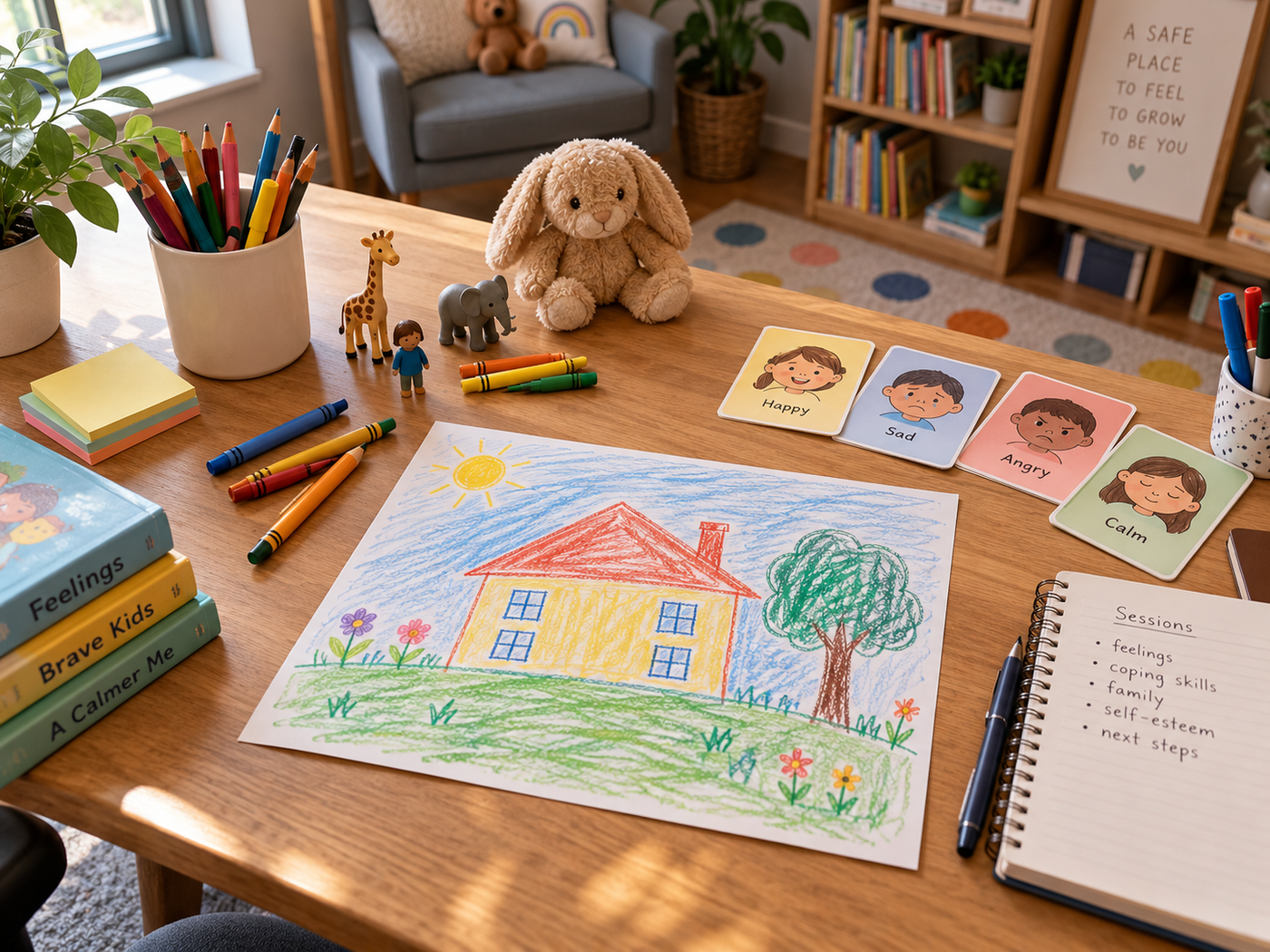
You found a drawing in the backpack. Everyone in the family is smiling except one small figure in the corner with no hands. You searched "children's drawings psychology" at eleven at night and now you are fairly sure your child is in crisis.
Take a breath. Psychologists do look at children's drawings, just not the way the internet says.
The myth of decoding
The popular version goes: black crayon means depression, missing hands mean helplessness, a tiny self-figure means low self-esteem. It is a tidy dictionary, and mostly wrong.
Children pick the crayon that is nearest, the one that is not broken, or the one their friend is not using. Hands are hard to draw, so they vanish. The self-figure is small because it was drawn last and ran out of room.
A single feature in a single drawing tells you almost nothing on its own.
Do drawing tests like Draw-a-Person actually work?
There are formal tools: the Draw-a-Person test, the House-Tree-Person, the Kinetic Family Drawing (draw your family doing something). As a way to open a conversation with a child, they are fine. As a measurement, they are weak. In a major review for the Association for Psychological Science, Lilienfeld, Wood and Garb (2000) found that the validity evidence for human figure drawings is even more limited than for other projective methods, and that "sign" interpretation, where one detail is read as one meaning, does not hold up. A later review in Psychology in the Schools reached a similar place: figure drawings remain popular with practitioners while the research behind sign-by-sign reading stays thin.
Drawing tests are a conversation starter with a clipboard, not an X-ray.
What psychologists do notice
Three things, none of them a crayon colour.
Change over time. One dark drawing is an afternoon. The same child who drew bright, crowded pages for a year and now draws small, empty ones for two months is a pattern worth asking about. Cathy Malchiodi, in Understanding Children's Drawings, argues that drawings have to be read against the child's developmental stage, context and history, never in isolation.
The child's own story. Ask "tell me about this" and the picture changes under your eyes. The figure with no hands is holding a ball behind his back. The sky is black "because the party was at night".
Feeling in the process. Did she press so hard the paper tore? Did he draw the dog, erase it, draw it again? Did they hide it or hand it over? That is where the emotion is, more than in the finished sheet. The Emotion map on this site works the same way: painting where a feeling sits says more than the shape you end up with.
What matters is the drawing in motion: how it changes, what the child says about it, and how it felt to make.
Winnicott's squiggle: drawing as a game for two
The paediatrician and psychoanalyst Donald Winnicott had a trick he used with children he had just met, described in Therapeutic Consultations in Child Psychiatry. He drew a quick squiggle and asked the child to turn it into something. Then the child made a squiggle and he had to finish it.
The genius of it is that nobody is being tested. The drawing belongs to both of them, so the child's imagination can come out sideways, as play, instead of being pulled out as an answer.
Winnicott was not reading signs; he was making a shared space and watching what the child brought into it.
The best way to understand a child's drawing is to draw with them.
The boa and the hat
The narrator of The Little Prince draws, as a child, a snake that has swallowed an elephant. Every adult sees a hat. He gives up drawing. Saint-Exupéry is joking about grown-ups, but it is also a precise picture of what goes wrong when we read a child's drawing with our own eyes instead of asking for theirs.
Every adult who said "hat" was decoding. The one person who could have said "tell me about it" never did.
Try this with a card
Use a metaphoric card from the home page or a drawing your child made this week.
- Choose, then squiggle. Let the child pick the card or drawing. Then each of you adds one small squiggle somewhere on a blank sheet beside it, and you swap: each turns the other's squiggle into something.
- Look together, say nothing first. Let the child speak before you do. If you must say something, say "hm".
- Two questions. "What is this one feeling?" and "If it could talk, what would it say?" Accept whatever comes, including "I don't know".
If the change in your child's drawings comes with changes in sleep, play, appetite or how they are at school, that is the point to bring the drawings to a child psychologist and let them look at the whole child, not just the paper.
And when you are the one who cannot find the words tonight: draw a card.