
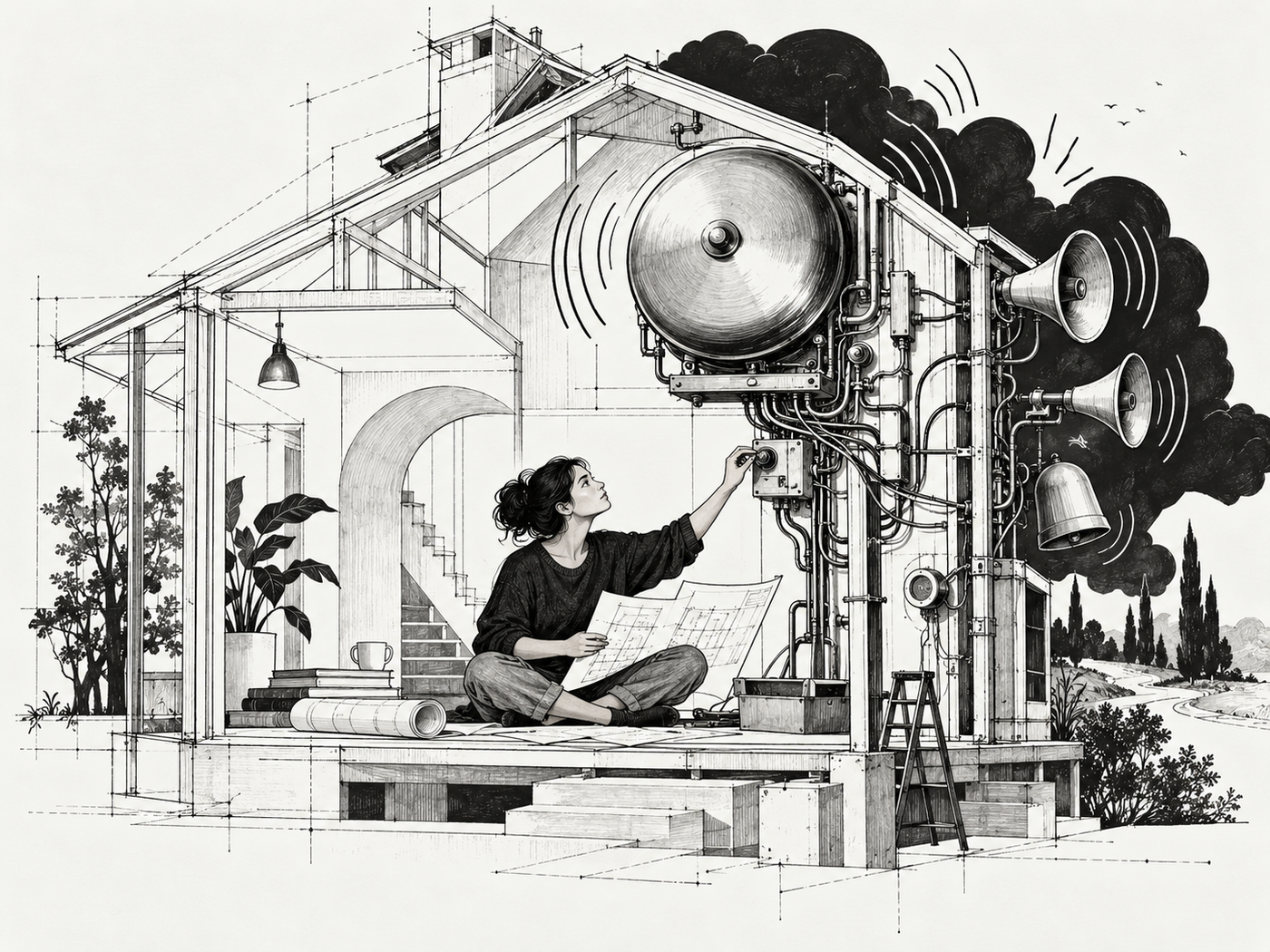
In 1896, American architect Louis Sullivan wrote that form ever follows function: a building's shape should grow out of its purpose. The idea shaped skyscrapers, spoons, and, it turns out, your 3 a.m. racing thoughts. 🏛️
Your anxiety has a form: a pounding heart, a tight chest, a mind spinning like a washing machine. And it has a function. Understanding that function won't make anxiety pleasant. But it can make it make sense.
The function: a built-in alarm system
Anxiety is part of the body's ancient defense system. When your brain detects a possible threat, it prepares you to act. Physiologist Walter Cannon described this "fight or flight" response in 1915. (Today we talk about freeze and fawn, too. See our post on the four trauma responses.)
Here's the form, and the function behind it:
- Racing heart → pumps blood to your muscles
- Fast breathing → brings in more oxygen
- Tense muscles → ready to move, now
- Butterflies or nausea → digestion is paused (lunch isn't a priority when you're running from a bear)
- Racing, narrow thoughts → all attention on the threat
Every "symptom" is a tool. It's just a tool built for a situation you may not actually be in.
Why the alarm is so sensitive: the smoke detector principle 🚨
Evolutionary psychiatrist Randolph Nesse explains this with what he calls the smoke detector principle (2001). Smoke detectors are designed to go off when you burn toast, because missing a real fire costs far more than a false alarm.
Evolution tuned our defenses the same way. Better a hundred false alarms than one missed predator. Nesse explores this in his book Good Reasons for Bad Feelings (2019).
So your anxiety isn't broken. It's overprotective. Which is annoying, like a bodyguard who tackles the pizza delivery guy. But the intention is loyal.
A little anxiety actually helps
In 1908, psychologists Robert Yerkes and John Dodson ran experiments (with mice, of all creatures) that inspired a famous idea: moderate arousal improves performance, while too much makes it worse.
A few nerves before an exam sharpen your focus. Too many, and you forget your own name.
When function becomes malfunction
Sometimes the alarm becomes too sensitive, too loud, or too frequent. That's when everyday anxiety can become an anxiety disorder.
Understanding the function explains anxiety. It doesn't excuse suffering. If anxiety is running your life, you don't just need to "understand it better." You deserve real support, and there are therapies, such as cognitive behavioral therapy, with strong evidence for treating anxiety disorders.
Working with your alarm, not against it 🛠️
- Thank it. Yes, really. "Thanks, I see you're trying to protect me." It sounds silly, and it softens the war with yourself.
- Ask what it's protecting. What's the "fire"? Rejection? Failure? Loss?
- Check the evidence. Is this burnt toast or a real fire?
- Send your body a safety signal. Breathe out slowly. Feel your feet on the floor. Look around and name five things you can see.
- Let it ring out. Anxiety rises and falls like a wave. Fighting it often makes it louder.
Good architects don't hate load-bearing walls. They design around them. Your anxiety is a load-bearing wall. It's holding something up. 🌿
Quick FAQ
Is anxiety good or bad?
Neither. It's a protective emotion. It's helpful in the right dose, and exhausting when the alarm is set too sensitively.
Why does anxiety feel so physical?
Because it's designed to prepare your body for action: heart, lungs, muscles, and digestion all change within seconds.
Can you get rid of anxiety completely?
No, and you wouldn't want to. The goal is a well-calibrated alarm, not a silent one.