
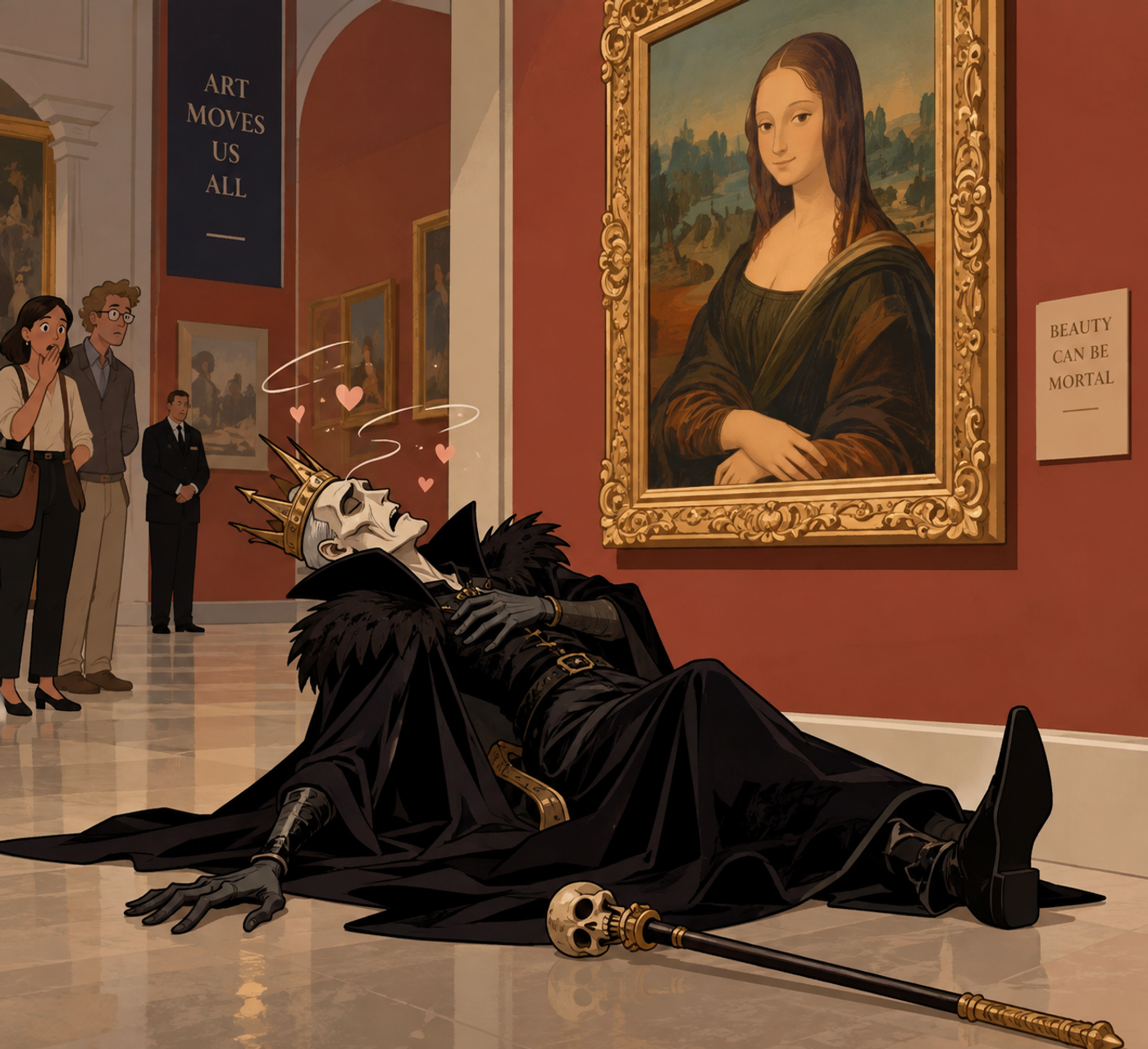
In January 1817, a French writer walked out of the Basilica of Santa Croce in Florence and nearly fell over. Not from too much wine. From too much beauty. 🎨
His name was Marie-Henri Beyle, better known as Stendhal. In his travel book Rome, Naples and Florence (1817), he described a kind of ecstasy among the frescoes and the tombs of Italy's great names. His heart pounded. Life seemed to drain out of him. He walked on, afraid he would fall.
Two centuries later, his name became a syndrome.
What is Stendhal syndrome?
Stendhal syndrome is an informal name for an intense physical and emotional reaction to art or beauty. People describe:
- a racing heart
- dizziness or fainting
- confusion or disorientation
- overwhelming emotion, tears, or even panic
The term comes from Italian psychiatrist Graziella Magherini. Working at Santa Maria Nuova hospital in Florence, she described 106 cases among visitors to the city between 1977 and 1986, and published her book La sindrome di Stendhal in 1989.
One important detail: it is not an official diagnosis. You won't find it in the DSM-5 or ICD-11. It's more a description than a disease.
Is Stendhal syndrome real?
The reactions are real. The label is debated.
Many cases may be tangled up with travel stress: jet lag, heat, dehydration, crowds, and the pressure to feel something profound in front of a masterpiece you flew across the world to see. That's a lot to ask of one nervous system before lunch.
In December 2018, an elderly visitor had a heart attack in front of Botticelli's The Birth of Venus at the Uffizi Gallery. Doctors who happened to be visiting saved him. The headlines shouted "Stendhal syndrome!" Whether beauty played a part, nobody can say for sure. His heart certainly did.
Stendhal syndrome also has some well-traveled cousins. Jerusalem syndrome and Paris syndrome, the latter described by Japanese psychiatrist Hiroaki Ota, both involve intense distress when a place collides with our expectations of it.
What beauty does to the brain 🧠
This is where neuroaesthetics, the science of how the brain experiences beauty, gets fun.
- In a 2011 study, neuroscientists Tomohiro Ishizu and Semir Zeki found that experiencing beauty, in both paintings and music, was linked to activity in the medial orbitofrontal cortex, a region involved in reward and pleasure.
- In 2001, Anne Blood and Robert Zatorre found that music that gives people "chills" activates the brain's reward circuits, the same systems involved in food and other pleasures.
So beauty isn't a luxury. Your brain treats it as a reward. And sometimes, when meaning and emotion arrive too fast, the system simply floods.
What it teaches us about emotions
- Emotions are physical. They live in your heart rate, your breath, your knees.
- Overwhelm isn't always about danger. Too much of a good thing can flood us too: art, love, awe, grief.
- Beauty opens doors. That's one reason art is used in therapy. Read more in our post on art therapy.
How to enjoy art without fainting on a Botticelli 😅
- Eat, drink water, and rest. Your soul may be hungry for art, but your body is hungry for a sandwich.
- Don't do five museums in one day. Choose three works, not three hundred.
- Sit down. Museums have benches for a reason.
- Let feelings come. Breathe slowly and let them move through you. Crying in a museum is allowed. Possibly even recommended.
- Know the limits. If you have chest pain or feel faint, get medical help right away. That's not the moment for art theory.
Quick FAQ
Is Stendhal syndrome a real medical condition?
It's not an official diagnosis, but the physical and emotional reactions people describe are real.
Where does Stendhal syndrome happen most?
It's most often associated with Florence, home to masterpieces by Botticelli, Michelangelo, and many others.
Can music or nature cause it too?
Many people describe similar overwhelming reactions to music, landscapes, or architecture. Research on "aesthetic chills" suggests the brain responds to beauty in many forms.