
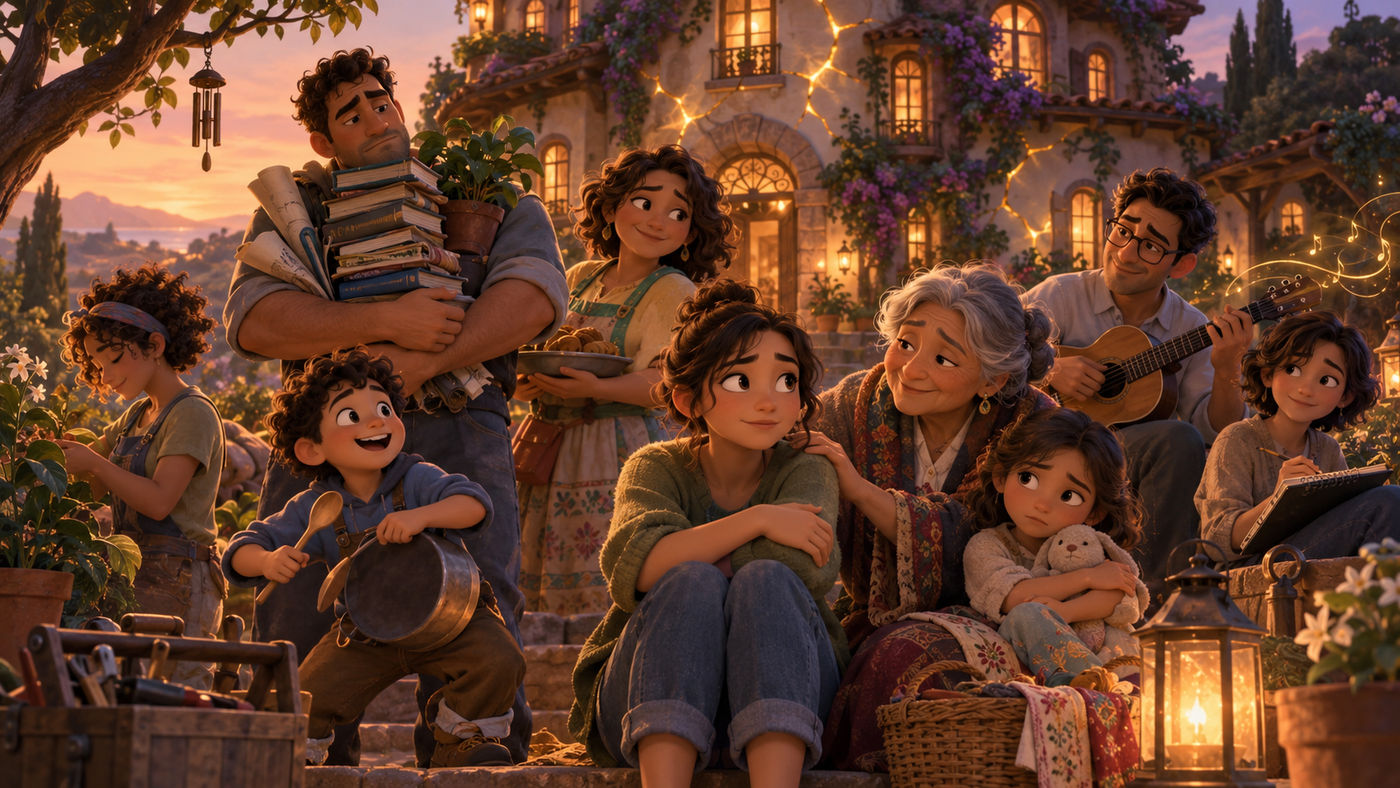
Disney made a movie about a family that looks perfect, carries an old wound, cracks under pressure, and sends away the one relative who says uncomfortable truths. In other words, a movie about generational trauma. Then everybody sang about it. 🎶 Therapists everywhere quietly nodded.
Encanto (2021) won the Oscar for Best Animated Feature. Its song "We Don't Talk About Bruno" became only the second Disney animated song ever to reach No. 1 on the Billboard Hot 100, and the first since 1993. Clearly, a lot of families recognized themselves.
The story in one breath (spoilers ahead)
The Madrigals live in a magical house, the casita, in the mountains of Colombia. Every child receives a special gift. Every child except Mirabel.
The magic began with Abuela Alma, who lost her husband when she was a young mother, fleeing her home with three babies. From that loss came a miracle. And, along with it, a lifelong fear of losing everything again.
Generational trauma: pain that gets passed down
Generational trauma (also called intergenerational trauma) describes how the effects of hardship can ripple into the lives of children and grandchildren. Mostly, it travels through what families learn: rules, fears, silences, and ways of loving.
Family therapy pioneer Murray Bowen called this the multigenerational transmission process. Abuela never says "be perfect or we'll lose everything." She doesn't have to. The whole family hears it anyway.
What about biology? A widely discussed 2016 study led by Rachel Yehuda found differences in a stress-related gene marker in children of Holocaust survivors. But the study was small and is still debated. The clearest path of transmission remains the one Encanto shows: what we learn at the kitchen table.
Family roles, Madrigal edition 🏠
In the 1980s, therapist Sharon Wegscheider-Cruse described typical roles children take on in families under strain. It's a lens, not hard science, but in the casita it fits suspiciously well, with a couple of Madrigal-specific additions:
- Isabela, the Hero. The "golden child." Perfect flowers, perfect smile, and a secret longing to grow something prickly. 🌵
- Luisa, the Strong One. She carries everything, literally. Her song "Surface Pressure" is basically a burnout anthem with better choreography.
- Bruno, the Scapegoat. He tells truths nobody wants to hear, so the family makes him the villain. He ends up living inside the walls, which may be the best metaphor for an exiled family member ever put on screen.
- Mirabel, the One Who Sees. Without a gift, she notices the cracks. In family therapy, the person labeled "the problem" is often the one sounding the alarm for the whole system.
The cracks are the point
The house literally cracks when the family pretends everything is fine. Nothing heals until Mirabel and Abuela finally talk honestly, by the river where it all began. That scene is a therapy session in everything but the invoice. 😄
And notice this: healing doesn't require a villain. Abuela isn't evil. She's a survivor who did her best with a broken heart and too much responsibility. She hurt her family and she loved them. Both can be true.
Then the family rebuilds the house together, and everyone gets to put their role down.
Movie therapy: try it yourself 🎬
Cinematherapy, using films to reflect on our own lives, was described in psychology journals as early as 1990. You don't need a therapist's office to start. After watching Encanto, ask yourself:
- Which Madrigal are you? Which one were you expected to be?
- Who, or what, is your family's "Bruno," the topic nobody talks about?
- If your family home had a crack, where would it be?
- What would your version of the river conversation sound like?
You don't need to share your answers. Just notice what comes up.
Quick FAQ
Is Encanto about generational trauma?
Many psychologists and viewers read it that way. The film centers on loss, family pressure, and reconnecting across generations.
What is the golden child in family psychology?
A popular term for the child who carries the family's hopes and must appear flawless. In Encanto, that's Isabela.
Can generational trauma be healed?
Patterns learned in families can be noticed, named, and changed, often with the help of family or individual therapy.
If this post brought up family memories that feel heavy, that's okay. A trained professional can help you untangle them gently.