
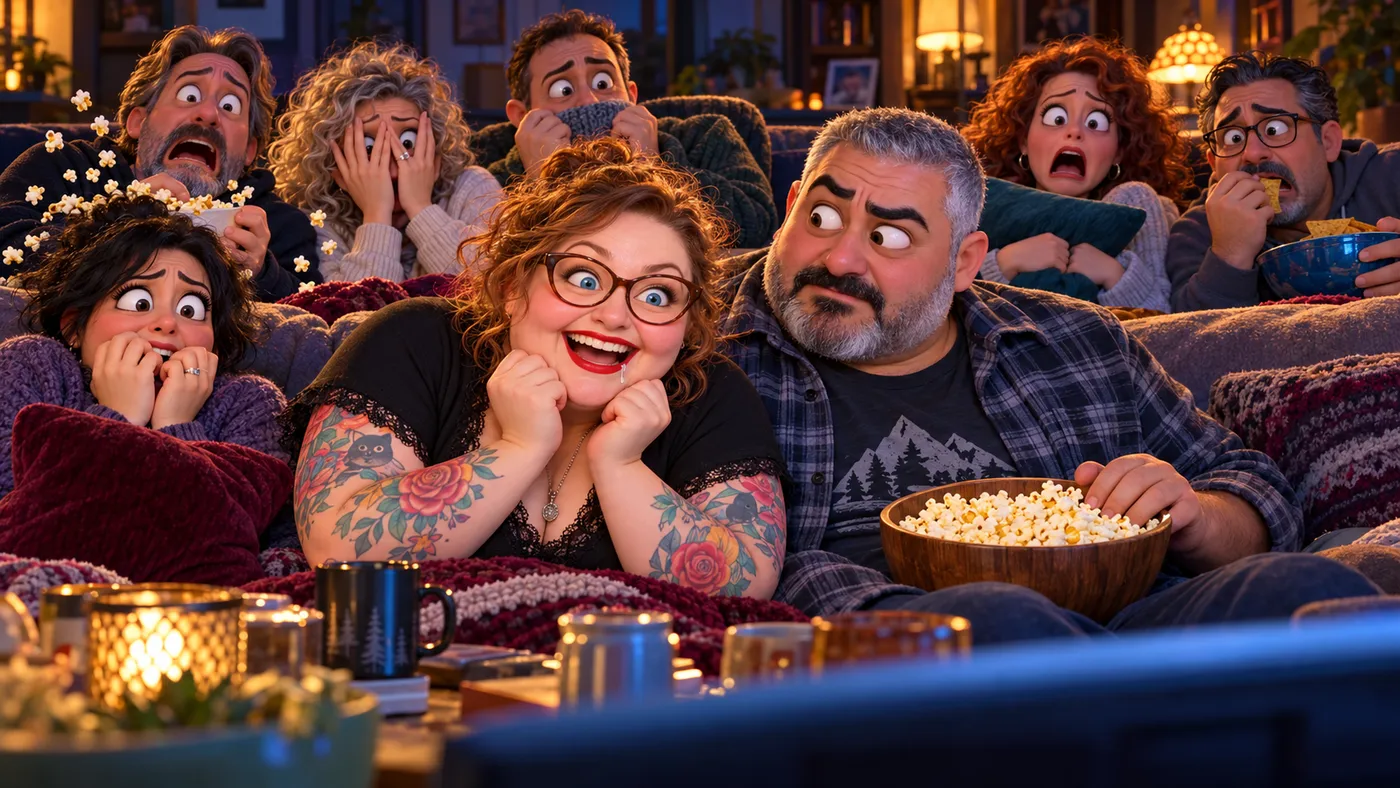
You bought a ticket to be frightened. You sat in the dark, your heart doing something athletic, and when the lights came up you felt oddly cleaned out. Then you did it again the following weekend.
The psychology of horror has a reasonable question to answer: why would an animal built to avoid threat spend money seeking it? The answers turn out to say a lot about how fear works when nothing is actually wrong.
Why does being scared feel good?
Psychologist Paul Rozin calls it benign masochism: enjoying things that the body initially reads as threats, like chili peppers, sad songs, roller coasters and horror films. The pleasure comes from the mind realizing the body has been fooled. Your alarm system fires, and then a quieter part of you notes that you are in a cinema seat holding popcorn. That gap between the alarm and the reality is the fun.
There is a second mechanism. Dolf Zillmann's excitation transfer theory, discussed in a recent study of horror film scenes, proposes that the arousal built up during suspense does not vanish when the threat resolves. It spills into whatever comes next, so relief feels like euphoria. The scarier the build, the sweeter the exhale.
Horror is a controlled experiment in which you get to be both the subject and the scientist.
Fear as rehearsal
Here is the part that moves horror from guilty pleasure to something closer to practice. During the first year of the pandemic, researchers asked whether a taste for frightening fiction predicted anything useful. In a study of 310 people, horror fans reported greater psychological resilience, and fans of apocalyptic and zombie films reported both resilience and a sense of preparedness.
The authors' explanation is a simulation hypothesis: scary stories let you rehearse coping with threat at low cost. You practise feeling dread and surviving it. You learn, in your body, that intense fear has a shape and an end.
Every horror film you finish is a small piece of evidence that you can be terrified and still be fine.
Is it catharsis, or something else?
The old idea is that horror "lets the fear out," like steam from a kettle. The research is sceptical about venting as a model of emotion. A well-known experiment on anger found that hitting a punching bag while thinking about a provocation made people angrier, not calmer. Emotions are not fluids with a fixed volume.
A better frame is mastery. You are not emptying fear; you are learning to hold it. That is also roughly what exposure work does in a therapy room, minus the soundtrack.
Get Out is the best recent argument that horror can carry something real. Jordan Peele builds his scares out of experiences that are not supernatural at all: the hand that lingers on your arm, the compliment that measures you, the smile that does not reach the eyes. The Sunken Place is a horror image, but what it describes is the feeling of watching your own life from behind glass while someone else drives. Audiences who had lived versions of that recognised it instantly. The film works because the fear is rehearsal for a threat that already exists, dressed in a genre that gives permission to feel it fully.
Good horror does not invent fear; it gives a familiar fear a face so you can finally look at it.
Try this with a card
Metaphoric cards have their own small horror genre. In every deck there is one image you skip past. This practice uses that one.
- Draw, but differently: spread a few cards face up and pick the one you least want to look at. Not the saddest. The one that makes something in you say no.
- Look at it for ninety seconds. Longer than is comfortable. Notice what your body does: breath, jaw, the urge to flip it over. Stay. This is the exposure.
- Ask two questions: What is this card certain will happen? and What does it not know about me? The first answer is the fear's script. The second is where your resources live.
If you want a wider frame for what the card stirs up, the pentagram can help you see which part of your life it is pointing at: body, feeling, mind, relationships, or meaning.
When the fear stops being fun
Horror works because the threat is not real. If the dread stays after the credits, if images intrude when you are trying to sleep, or if everyday fear has started shrinking your life, that is a reason to talk to a professional rather than to watch something scarier.
Otherwise, the deck is waiting, and so is the card you keep avoiding. Draw one and see what it is certain about.