
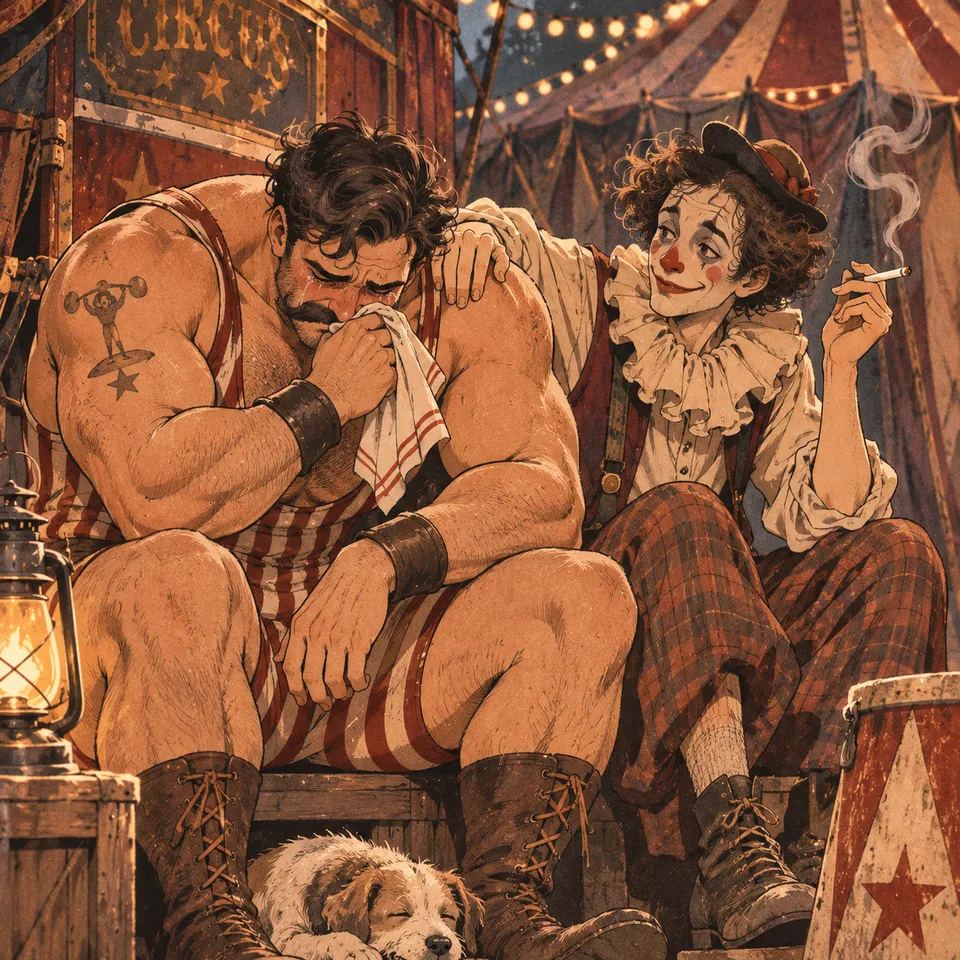
You felt it rise in the cinema, or at the funeral, or in the car after the phone call. The throat tightening, the eyes going hot. And you did the thing. Jaw set, breath held, blink hard, look at the ceiling. It passed. Nobody saw.
Men and crying have a complicated arrangement, and most of it was signed before you could read.
Why do humans cry at all?
Other animals produce tears to protect the eye. Only humans weep from feeling. Dutch psychologist Ad Vingerhoets spent his career on this puzzle and laid it out in Why Only Humans Weep, published by Oxford University Press in 2013. His argument, in short: tears are a signal. They tell the people around you that you are overwhelmed and that attack would be pointless. Babies cry loudly to summon help from a distance; adults cry quietly, and the tears work at close range, on the faces that are already near.
Research from his group suggests observers respond to a tearful face with more willingness to help and a stronger sense of connection, as summarised in The social impact of emotional tears, published in Motivation and Emotion.
Tears are not a leak. They are a message addressed to someone.
Which raises the obvious question. If tears are a message, what happens when you keep returning them to sender?
What does holding it in cost?
James Gross at Stanford has studied emotion regulation for decades, and one strategy keeps showing up as expensive: expressive suppression, the act of feeling something and keeping it off your face. In a four-year longitudinal study led by Tammy English with Gross and colleagues, students who habitually suppressed were rated by peers as less close and less warm years later. They were not disliked. They just were not known.
The American Psychological Association, in its practice guidelines for working with boys and men, describes traditional masculinity norms, including emotional restriction, as linked to poorer mental health outcomes and reluctance to seek help.
Suppression does not make you tough. It makes you a stranger to people who love you.
There is a dry irony here. The man who never cries is often praised for being solid. Then one day he wonders why nobody really knows him, and the answer was in the thing he was praised for.
Does crying actually make you feel better?
Not always, and it is worth being honest about that. Vingerhoets and colleagues reviewed the evidence in Is crying a self-soothing behavior? and found a split. Crying alone does seem to involve calming physiology, a shift toward the parasympathetic side of the nervous system. But the clearest mood improvement comes when someone else responds. Comfort from another person is what turns tears from discharge into repair.
This is the thing Good Will Hunting understands. Will spends the film being brilliant and untouchable, deflecting every attempt at closeness with a joke or a fist. The scene everyone remembers is not clever. Sean simply repeats a sentence until Will stops arguing with it, and then Will cries, and Sean holds him. What matters is not the crying. Will has presumably cried alone before. What matters is that he cries while being seen, and that the man seeing him does not flinch, fix, or leave.
The repair is not in the tears. It is in who stays while you cry them.
What changes when you cry in front of someone
Something shifts in the relationship, and it is usually not what you fear. You expected contempt; you mostly get attention. You expected to be smaller; you often feel more solid afterwards, because the thing you were guarding turned out to be survivable.
Not everyone is safe to cry with. Some people will be awkward, some will try to fix you, a few will use it. Choosing carefully is not cowardice. It is the same instinct Vingerhoets describes: tears are for close range, for faces already near.
Try this with a card
If crying feels locked, you can approach it sideways.
- Draw a card and set it down. Do not interpret it yet.
- Look for the softest thing in the image: a texture, a shadow, a figure turned away. Let your eyes rest there. Notice your throat and chest.
- Ask two questions. Who in my life has seen me cry? And: Who would I want to? If the second answer surprises you, write down the name.
If naming the feeling is the hard part, the Emotion map gives you more words than "fine."
You do not have to cry today. You only have to stop treating the urge as an enemy.
If tears have stopped coming at all, or if they come constantly and you cannot say why, that is worth a conversation with a therapist rather than a thing to wait out.
Or start smaller: draw a card and see what it finds in your chest.