
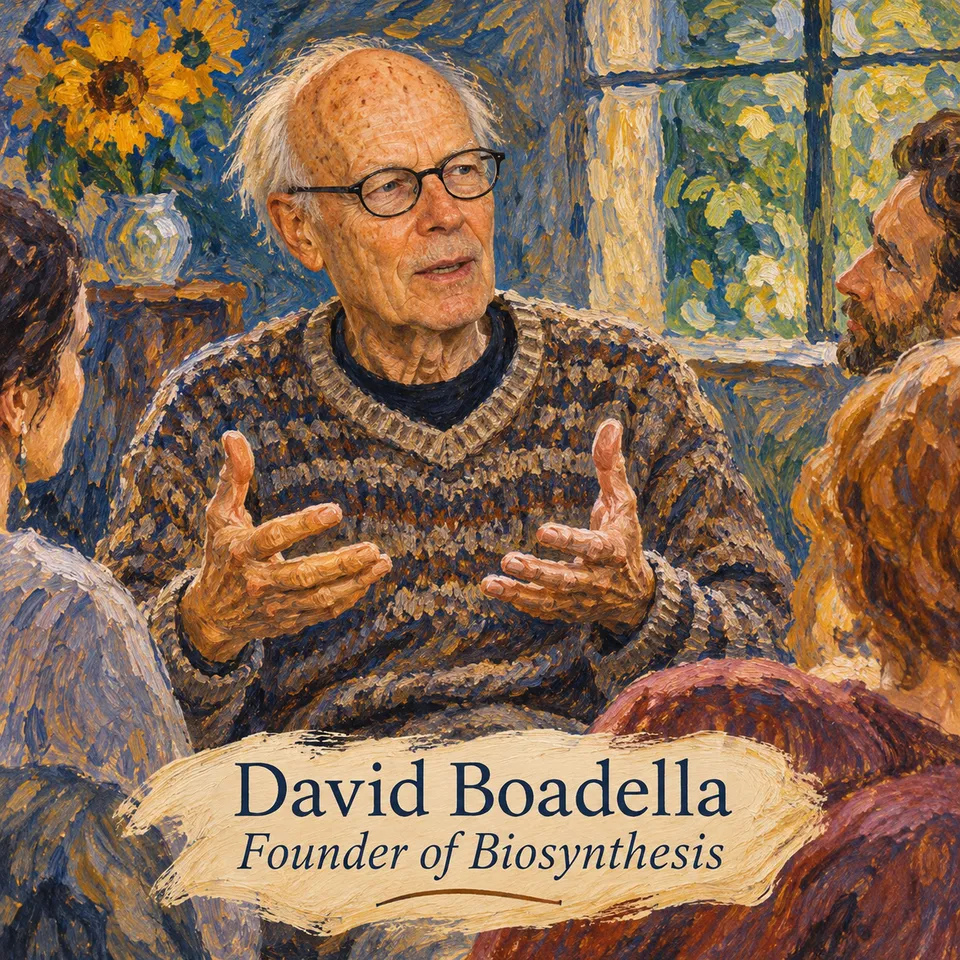
You're curious, and the word isn't helping: biosynthesis. It sounds like something that happens in a cell under a microscope. It does — that's where the name was borrowed from — but in a therapy room it means something you can feel in your shoulders.
Where it comes from
David Boadella, an English psychotherapist, developed Biosynthesis from the 1970s out of the body-oriented tradition that began with Wilhelm Reich — the first analyst to insist that the way a person holds their muscles is their history. Reich's followers could be rough; Boadella made the method gentle, and gave it a name from embryology.
The idea: in the first weeks of life, an embryo has three layers of tissue. One becomes the gut and organs, one becomes muscle and bone, one becomes skin and nervous system. Boadella's proposal was that these three layers grow into three "life streams" in a person — feeling, action and thinking — and that trouble is what happens when the streams lose contact with each other. You know what you feel but can't act. You act but don't feel. You think about all of it, brilliantly, from a distance.
Biosynthesis means "integration of life". Three streams, one river — or that's the aim.
What happens in a session?
You talk, and while you talk, attention is paid to the body: where the breath stops, what the jaw does, how the feet meet the floor. Three words come up a lot:
Grounding — your contact with the floor and with reality. People in panic lose their feet; the work literally begins with finding them again.
Centring — breathing and the middle of the body; the place where feeling lives before it has a name.
Facing — eyes, face, contact with another person. What happens between you and the therapist when you're actually looked at.
Sometimes there's a small movement to try, a hand placed where the breath won't go, a sound. Clothes stay on. Touch is used only with agreement and only when it helps; much of the work is done with attention alone. Nobody is "released" dramatically. Things loosen, sometimes with tears, more often with a yawn — which is the body's way of saying finally.
The body isn't asked to perform. It's asked what it's been holding, and given a moment to answer.
Why work with the body at all?
Because the body is where the unfinished business is kept. A fright that was never discharged stays as bracing. A grief that couldn't be cried stays as a tight chest. You can understand all of this perfectly and still have the tight chest — insight is wonderful and it doesn't breathe for you. The neuroscience of the last two decades has mostly confirmed what body therapists said in their stubborn way for seventy years: the nervous system settles through the body, in contact with another settled body, and not through argument.
Insight explains the knot. The body unties it.
Who is it for?
People who think a lot and feel late — who can tell you precisely what's wrong and can't shift it. People whose bodies carry what words haven't reached: chronic tension, numbness, panic, a stomach that keeps its own counsel. People recovering from trauma, where talking alone can re-open rather than heal. And, frankly, anyone who's spent a decade in talk therapy and would like their neck to attend.
It suits less well someone who wants to stay strictly in ideas, which is a legitimate wish and a thing to say in the first session.
And how does it fit with Gestalt?
Beautifully, which is why some therapists train in both. Gestalt asks what is happening now, between us; Biosynthesis asks the same question and includes the diaphragm in "us". One gives the dialogue, the other gives it a body.