
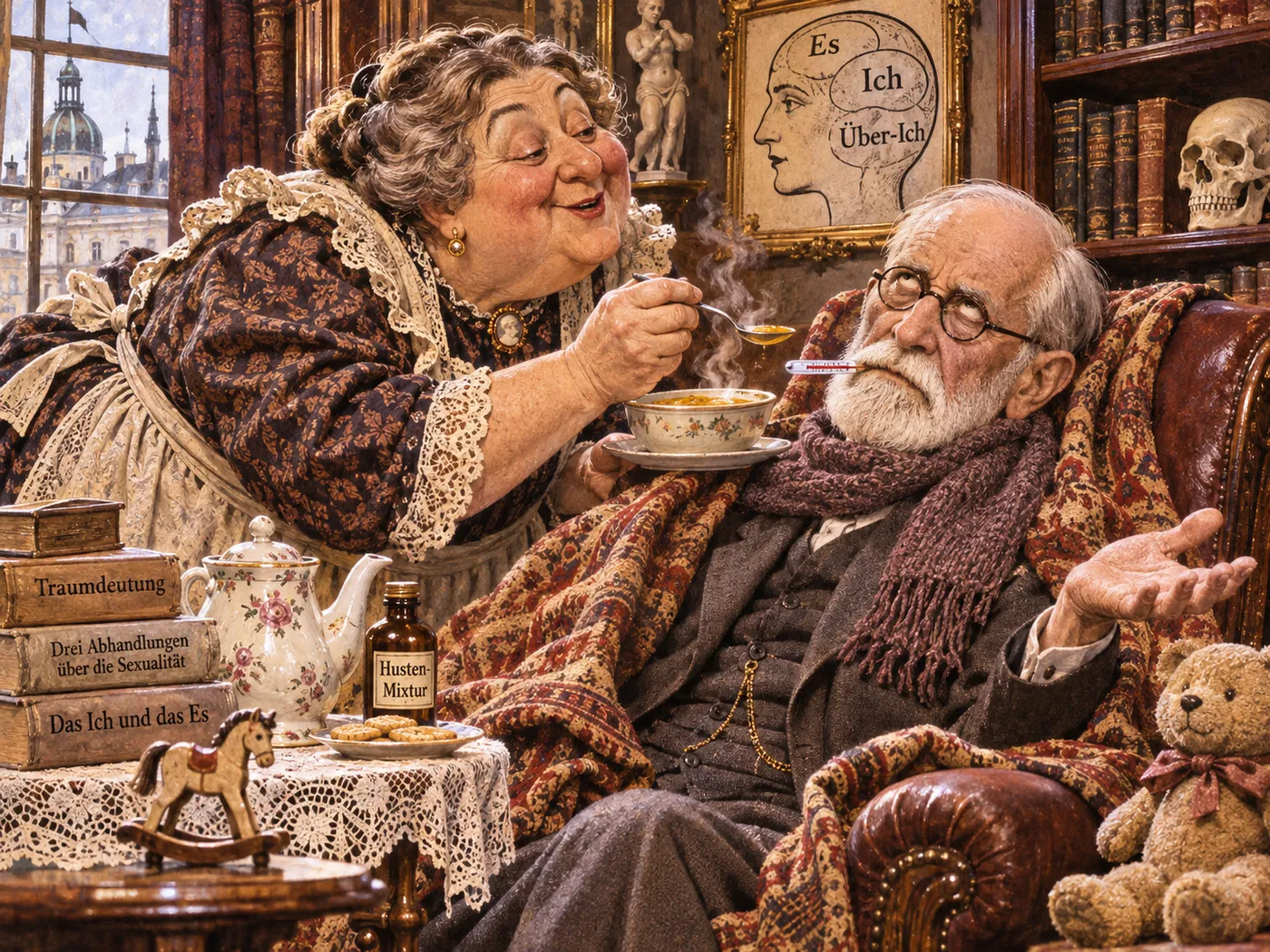
You're curious — and braced. The word psychoanalysis comes with a bundle of pictures: the couch, the beard, the silence, the inevitable moment where your mother is found guilty. Let's unpack the bundle, which is itself a very psychoanalytic thing to do.
So — my mother?
Not on trial. Psychoanalysis is interested in your mother for the same reason a geologist is interested in the lower layers: that's where the pattern started. The claim isn't that she did something wrong. It's that you learned, very early and without knowing it, how closeness works, what anger costs, what you must do to be loved — and that you've been running those lessons ever since, with people who never signed up for them. Your mother is a witness, not the accused. Often a sympathetic one.
Psychoanalysis doesn't blame the past. It notices that you're still living in it.
What is it, in one paragraph?
Freud's wager, around 1900: most of what moves us is not available to us. Not hidden by a villain — just below the waterline, the way most of a person's digestion is. Slips, dreams, the thing you keep doing although you've decided not to: those are the unconscious showing an ankle. The method he built is almost absurdly simple. You say whatever comes to mind, without tidying (free association). The analyst listens for the pattern under the words. And, crucially, the pattern shows up in the room — you start treating the analyst the way you treat everyone important, which is called transference and gets its own post in this series.
Say everything. Watch what repeats. Notice who the analyst has turned into.
Does it still exist?
In two sizes. Classical analysis — three to five sessions a week, often on the couch, for years — is rare and expensive and still practised. Its large modern child is psychodynamic therapy: once a week, two chairs, the same ideas (the unconscious, patterns from early relationships, transference) at a pace ordinary life allows. When someone today says "my therapist is psychoanalytic", this is almost always what they mean.
Does it work? Everyone says it doesn't.
Everyone said that, loudly, in the 1990s, when the only therapies with trials were the ones designed to have trials. The picture has changed. A 2010 review in American Psychologist pulled the research on psychodynamic therapy together: effects as large as those of other established therapies — and, unusually, effects that kept growing after therapy ended, as if people went on using what they'd learned. Long-term analysis for complex problems has decent evidence too, though it will never have the tidy trials of a twelve-week manual.
It works. It just refused for a century to prove it in the format the examiners wanted.
What did it give everyone else?
Nearly everything. The idea that a therapist should have their own therapy. Supervision. Confidentiality as a sacred thing. The notion that the relationship in the room is the treatment. Defence mechanisms, which you use every day by name — projection, denial, rationalisation. Gestalt was born out of psychoanalysis — Fritz Perls was an analyst who got into an argument and never came back. CBT was built by a disappointed analyst. IFS speaks in its grandchild's accent. You can dislike psychoanalysis; you can't do therapy without it.
Why love it and not do it?
Because a greedy learner has a finite week. Training as an analyst takes the better part of a decade; a Gestalt therapist who loved the ideas enough to read them for years still has to choose where to put her hands. The love is real — the depth, the patience, the respect for how slow a person actually is. The practice is someone else's. That isn't a contradiction. That's how a field works: you know your neighbours' houses, and you live in yours.
Where it was done well — and badly, lovingly
Woody Allen's Annie Hall (1977): "I've been in analysis for fifteen years. I'm going to give it one more year and then I'm going to Lourdes." Every analyst has laughed at it and recognised the client. For the real thing, read Stephen Grosz's The Examined Life (2013): short true stories from an analyst's room, which do what the method does — make the obvious strange.