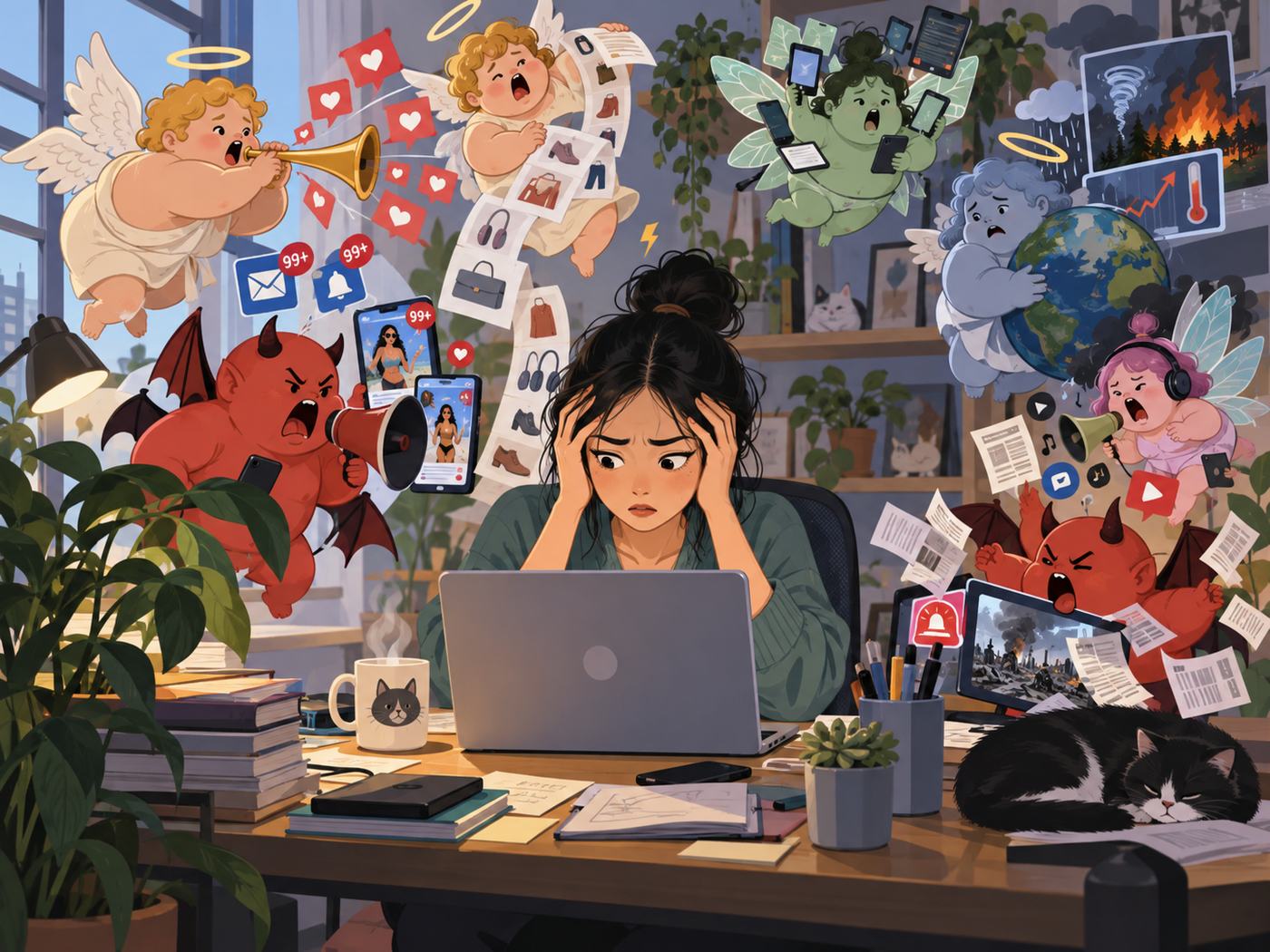
Your ancestors worried about lions. You still worry about lions. It's just that the lion is now an unread email, 47 open tabs, a climate report, and a group chat that went suspiciously quiet. 🦁
If you feel anxious more often than you'd like, you're in very large company. According to the World Health Organization, anxiety disorders are the world's most common mental disorders, affecting an estimated 470 million people in 2023. In the first year of the COVID-19 pandemic alone, global rates of anxiety and depression rose by about 25%.
So no, it's not just you. Let's look at why modern anxiety runs so high.
Your brain is running very old software 🧠
Our anxiety system was built for short, physical dangers: spot the threat, run, rest.
Modern threats are different. They're long, abstract, and endless. There's nothing to fight and nowhere to run. So the alarm doesn't switch off. It just hums in the background, all day, like a fridge you only notice when it stops.
Five modern anxiety amplifiers
- The infinite feed. "Doomscrolling," compulsively consuming bad news, is now studied by psychologists. Research links it to higher psychological distress and lower well-being (Satici et al., 2023). That's a link, not proof of cause, but your thumb probably already suspected.
- Too many choices. In The Paradox of Choice (2004), psychologist Barry Schwartz argued that more options can bring more doubt and regret. Freedom is wonderful. Choosing between 34 kinds of oat milk is not.
- Climate worry. A 2021 Lancet Planetary Health survey of 10,000 young people in 10 countries found that 59% were very or extremely worried about climate change. More than 45% said those feelings affected their daily lives. Eco-anxiety isn't irrational. It's a reasonable response to a real problem. 🌍
- Always-on comparison. How much social media drives anxiety is hotly debated. Jonathan Haidt's The Anxious Generation (2024) argues that smartphones rewired childhood. Researchers such as Candice Odgers, writing in Nature, argue the evidence for cause and effect is weaker than the headlines. The truth is probably more complicated than either side's book cover.
- Freedom itself. In 1844, philosopher Søren Kierkegaard compared anxiety to dizziness: the vertigo we feel standing before endless possibility. Nearly two centuries later, it still holds. Now with Wi-Fi.
Anxiety or anxiety disorder?
Anxiety is a normal human emotion. Everyone feels it. It's often a sign that something matters to you.
It becomes something to get help for when it's intense, lasts a long time, and gets in the way of life: your sleep, work, or relationships. Effective treatments exist, yet WHO estimates that only about 1 in 4 people with an anxiety disorder receives treatment. If that's you, you deserve to be in that quarter.
Small ways to turn down the volume 🔉
- Give the news a time slot. Twice a day, not all day. The world will still be there at 6 p.m.
- Choose "good enough." For small decisions, pick the first option that works. Perfect is a time thief.
- Move your body. Anxiety is energy looking for an exit. A walk counts.
- Name what you feel. Putting feelings into words can calm the brain's alarm system. (More on this in our post on metaphorical cards for anxiety.)
- Breathe out longer than you breathe in. A slow exhale tells your nervous system it's safe to stand down.
- See actual humans. Group chats are nice. Faces are better.
And if your anxiety feels like an overprotective bodyguard, you're not wrong. That's exactly what our post Form Follows Function: Why Your Anxiety Has a Job is about.
Quick FAQ
Why is anxiety increasing?
Researchers point to many overlapping factors: the pandemic, economic stress, information overload, climate concerns, and loneliness. No single cause explains it all.
Is it normal to feel anxious all the time?
Feeling anxious sometimes is normal. Feeling anxious most of the time, in a way that disrupts your life, is worth talking to a professional about.
What is eco-anxiety?
Distress about climate change and the future of the planet. It's increasingly common, especially among young people.
Sources
- World Health Organization. Anxiety disorders fact sheet
- WHO (2022). COVID-19 pandemic triggers 25% increase in prevalence of anxiety and depression
- Hickman et al. (2021). Climate anxiety in children and young people. Lancet Planetary Health
- Odgers (2024). The great rewiring: is social media really behind an epidemic of teenage mental illness? Nature
- Satici et al. (2023). Doomscrolling Scale. Applied Research in Quality of Life