
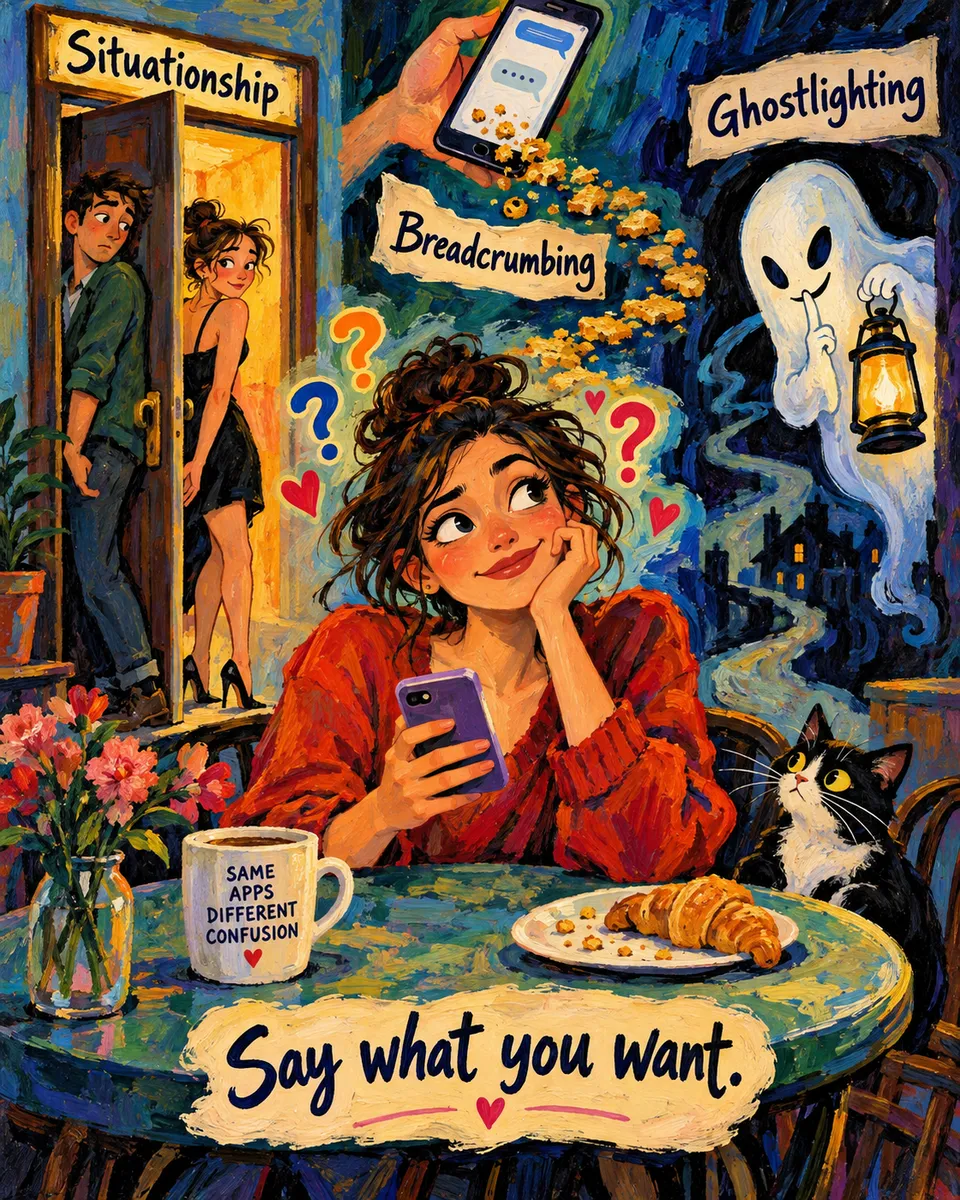
You have been seeing someone for four months. You have a toothbrush at their place and no idea what you are. When a friend asks, you reach for a word, and the word is a meme.
The 2026 dating dictionary keeps growing: situationship, breadcrumbing, ghostlighting, and whatever gets coined next week. The slang is funny because it is accurate. But every one of these words is a label for a feeling you have not said out loud yet. Let's translate.
What is a situationship, really?
A situationship is a relationship with the definition removed. Everything else is present: sex, texts, Sunday mornings. What is missing is a shared answer to "what is this?"
Psychologists have a plainer word for it: ambiguity. Uncertainty about where you stand is not neutral; it keeps part of you on alert, scanning for clues. You reread messages. You count hours between replies. You become a small detective in your own love life.
A situationship is not a type of relationship. It is a question nobody has asked yet.
Often one person likes the question unanswered, because the answer costs something. The other person tells themselves they are fine with "going with the flow" while quietly drowning in it.
Why does breadcrumbing hurt more than ghosting?
Breadcrumbing is the slow drip: a like, a "miss you", a plan that never becomes a date. Just enough contact to keep you hoping.
This is intermittent reinforcement, described by Ferster and Skinner in Schedules of Reinforcement (1957). Rewards that arrive unpredictably produce the most persistent behaviour of all. Pigeons kept pecking long after the grain stopped. You keep checking your phone.
The research backs the feeling. A Spanish study of 626 adults found that people who had been breadcrumbed reported more loneliness, more helplessness and lower life satisfaction. Being ghosted, surprisingly, was not linked to the same distress. The authors suggest that ghosting at least ends; breadcrumbing never lets you grieve.
The crumbs are not a sign they care a little. They are a sign you are being kept available.
Ghostlighting and the newer words
Ghostlighting is when someone disappears, then returns and insists they never left — or that you are overreacting. Two injuries in one: the absence, and then being told your memory of the absence is wrong.
Most of the newer slang follows this pattern. The behaviour is old; the name is new. What the name offers is permission. Once there is a word for it, you stop assuming you imagined it.
That is the real gift of the dating dictionary. It is not a field guide to bad people. It is a glossary of feelings people did not know they were allowed to have.
What Challengers knows about ambiguity
In Luca Guadagnino's Challengers, three people spend thirteen years refusing to say what they want from each other. Every rally is a conversation they are not having. Tashi, Art and Patrick are brilliant at tennis and hopeless at sentences.
What the film understands is that ambiguity is not an accident. It is a strategy. As long as nothing is named, nobody has to lose. The cost is that nobody gets to win either — just a very long, very sweaty deuce.
Unspoken wants do not go away. They just start playing dirty.
How to name what you actually want
Here is the quiet secret under all the slang: the words describe what they are doing. None of them describe what you want. And that is the only part you control.
Try finishing this sentence privately before you say anything to anyone: "What I want from this is…" If the honest ending is "to know where I stand", that is a complete want. It does not need to be a demand for commitment. It is a request for a shared definition.
The Emotion map can help if the feeling is murky. Often what sits under "confused" is "hopeful and scared at the same time" — and that is a much more useful thing to know.
Try this with a card
- Draw a card and set it beside your phone, screen down.
- Look at the image for a full minute. Notice who or what is in the centre, and what is at the edge.
- Ask two questions. "If this card is the situationship, where am I in the picture?" Then: "What would I have to say for the picture to change?"
Write the second answer down. It is usually one sentence, and it is usually the one you have been avoiding.
If the waiting has become a loop you cannot leave — checking, hoping, crashing, repeating — a therapist can help you understand why the uncertainty feels so familiar.
When you are ready, draw a card and ask it the question nobody else has.