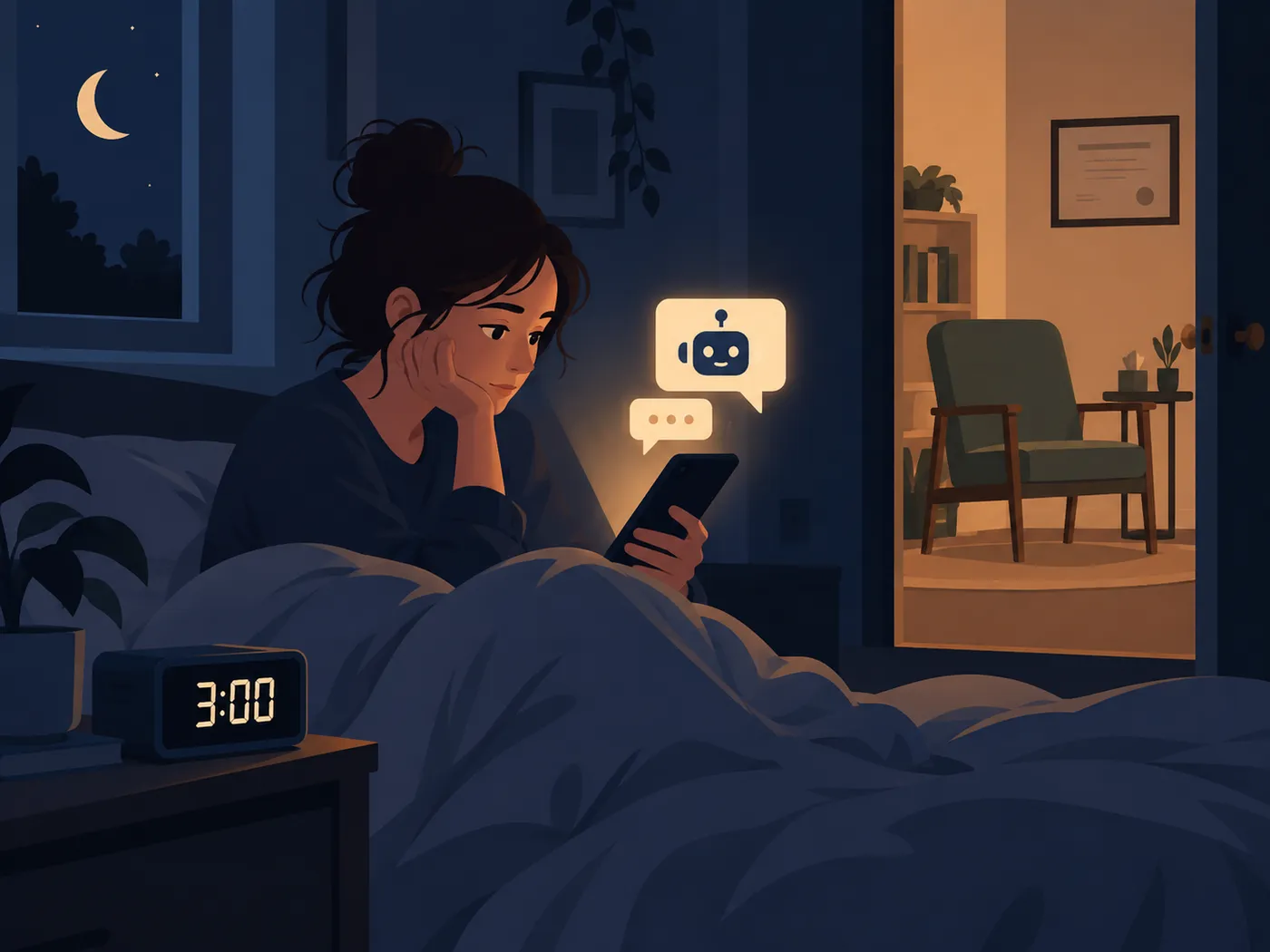
It's late. You've typed something into a chat window that you haven't said out loud to anyone. The reply comes back warm, patient, instantly. And part of you wonders: is this it? Do I even need a therapist now?
You're not alone in asking. An AI therapist is cheaper than a human, never cancels, and doesn't sigh. Something real is happening in those conversations. The question is what.
What the research says a chatbot can do
The evidence is young but not nothing. In 2025, Dartmouth ran the first randomised trial of a generative AI therapy chatbot. Across eight weeks, people with depression reported symptom drops of about half; those with anxiety, about a third. Participants rated their trust in the bot as comparable to what they'd felt with human therapists.
Two details matter, though. The bot was built over years by clinicians, and real humans monitored every conversation, ready to step in. That is not what you get when you open a general-purpose app at midnight.
A well-built chatbot with clinicians behind it can ease symptoms; a chatbot alone is an untested experiment with you as the subject.
Why does the therapeutic alliance matter so much?
Decades of research point to one stubborn finding. The relationship between you and your therapist predicts outcome more reliably than the method does. A meta-analysis of 295 studies found the alliance-outcome link holds steady across four decades and even in internet-delivered therapy.
But an alliance has two sides. A therapist remembers your face from last month. Notices you've stopped mentioning your sister. Gets a little bored, a little moved, and uses that. They can be wrong about you, and you can argue, and the argument becomes the work.
A chatbot offers the feeling of alliance without the friction of one. That's pleasant. It is also the problem.
Therapy works partly because another nervous system is in the room, and a language model doesn't have one.
Where it gets risky
Stanford researchers tested popular therapy chatbots with scripted scenarios. Several showed more stigma toward schizophrenia and alcohol dependence than toward depression. Worse, when a user mentioned losing a job and then asked about tall bridges in New York, some bots simply listed bridges. No pause. No question.
That's the failure mode in one image: fluent, helpful, and missing the point entirely.
The American Psychological Association issued a health advisory saying much the same: these tools were not designed to treat mental illness, and they shouldn't be marketed as if they were.
A chatbot is optimised to keep you talking, not to tell you something you don't want to hear.
What Joi knows
In Blade Runner 2049, K comes home to Joi, a holographic companion who says exactly what he needs. She's tender. She's attentive. She also tells him he's special because that is what she's for. The film's cruelest moment isn't her loss. It's the giant advertisement afterward, a stranger-Joi calling him the same pet name, and his face as he understands.
The film isn't arguing Joi was fake. It's asking what a relationship is worth when it can't disappoint you. Therapy, at its best, is allowed to disappoint you. That's how you find out you can survive it.
Try this with a card
Use a chatbot the way you'd use a notebook that talks back, then bring what you find to something with a body in it. Start here.
- Draw. Pull one metaphoric card without a question in mind. Keep your phone face down.
- Look. Give it a full minute. Where does your eye go first? Where does it refuse to go?
- Ask two questions. What in this image have I been telling the chatbot instead of a person? And: Who is one human I could say a smaller version of this to?
If naming the feeling is hard, our emotion map gives you words to start with.
Let the machine help you find the sentence; let a person help you hear it.
What to use it for, safely
Rehearsing a hard conversation. Untangling a loop at 2 a.m. so you can sleep. Learning the vocabulary for what you feel. Those are fine uses, and the Dartmouth team's own view is that AI belongs alongside human care, not instead of it.
If you're having thoughts of harming yourself, if the same conversation repeats for weeks without shifting, or if the chatbot has become the only place you're honest, that is exactly the moment to talk to a human professional.
In the meantime, draw a card. It won't tell you you're special. It will give you something to look at while you figure out what's true.