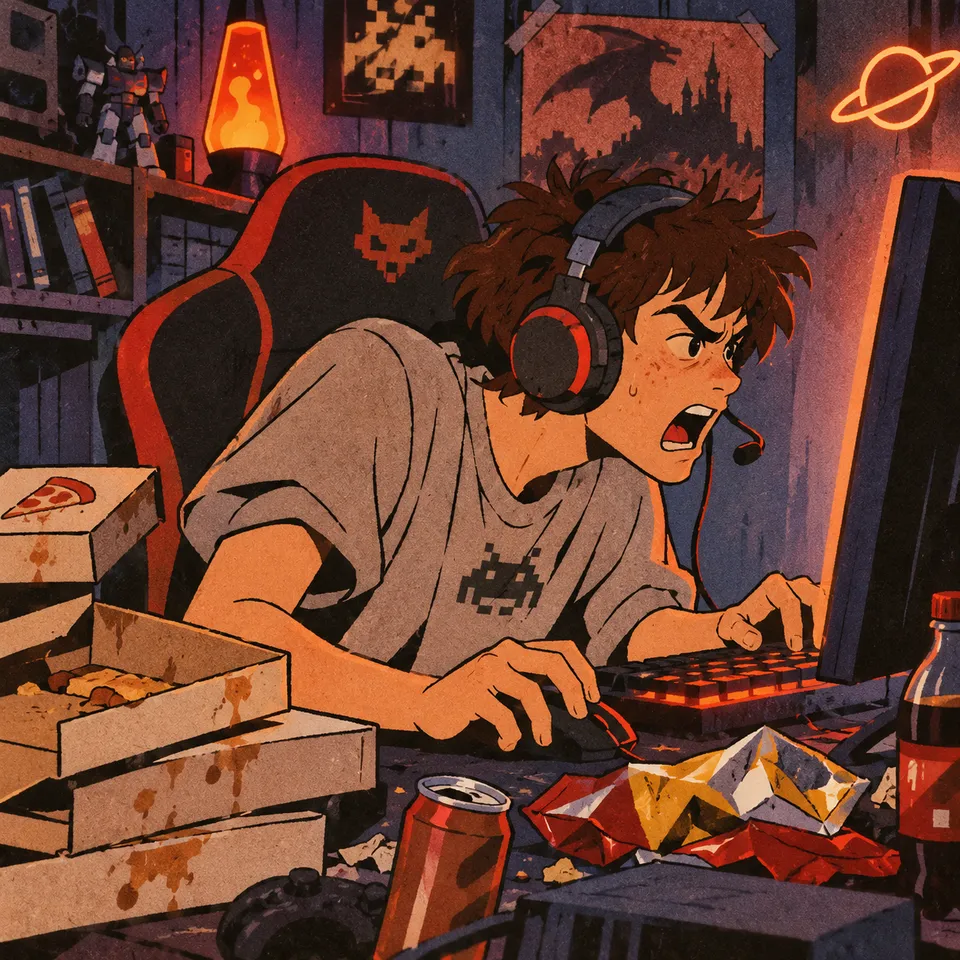
It is 2 a.m. again. You told yourself one more match, or one more tab, and now the window is grey and you feel the specific flatness that follows. You close the laptop with a small, private contempt for yourself.
Porn and gaming addiction in young men is a topic that attracts two kinds of loud people: those who say it is destroying a generation, and those who say it is nothing. You are one person, tired, trying to work out whether this is a problem or just a habit you dislike.
What actually counts as addiction?
The World Health Organization added gaming disorder to the ICD-11. The definition is narrower than the panic suggests. Three things have to be true, usually for at least twelve months: you have lost control over when and how much you play, gaming has pushed other interests and responsibilities aside, and you keep going despite clear harm. The WHO is explicit that this applies to a small proportion of people who game (WHO).
Porn is handled differently. The ICD-11 does not list "porn addiction" at all. It lists compulsive sexual behaviour disorder, an impulse-control condition where repeated sexual behaviour becomes the centre of life and continues despite harm and attempts to stop (WHO ICD-11, 6C72). Note the words: centre of life, despite attempts to stop. Not "more than I think I should".
Doing something a lot is not addiction; losing the ability to choose is.
Is porn addiction even real?
Joshua Grubbs and colleagues pooled dozens of studies and found that the strongest predictor of feeling addicted to porn was not how much porn someone watched. It was moral incongruence: using porn while believing it is wrong. Actual frequency of use was only weakly related to self-reported problems (Grubbs et al., 2019).
Two men can watch the same amount. The one who believes he is a degenerate for it is far more likely to call himself an addict, lose sleep, and watch more to manage the distress of watching. Shame is not the brake. Shame is the accelerator.
Gaming tells a similar story. When Andrew Przybylski's team applied the proposed internet gaming disorder criteria to large samples of adults, only a tiny fraction met them, and those who did were not clearly worse off in health than those who did not (Przybylski, Weinstein & Murayama, 2017). That does not mean nobody suffers. It means the suffering is more specific than "plays too much".
If your main symptom is self-disgust, the behaviour may be less of a problem than the disgust.
What is the behaviour for?
Steve McQueen's film Shame is often described as a film about sex addiction. It is more accurate to say it is a film about a man who cannot be touched. Brandon has the apartment, the job, the body, the routines. What he does not have is a single relationship in which he is known. The sex is relentless and, crucially, joyless. It is not pleasure he is chasing. It is the brief absence of himself.
The film's quietest scene is a dinner date where a woman asks him ordinary questions and he cannot answer them. The compulsion is downstream of the loneliness, not the cause of it.
This is the question a therapist will eventually ask you, and it is worth asking yourself first: what does the behaviour do for you? Common answers: it turns the volume down. It is the only time nobody wants anything. It is the one place I am good at something. It stops me thinking about her, or him, or the exam, or my father.
Every one of those is a real need. The game or the tab is a clumsy way of meeting it, and you do not fix a clumsy solution by hating the person who found it.
The behaviour is a messenger, and you have been shooting it.
Try this with a card
A short practice for the morning after, when the contempt is loudest.
- Draw. Pull a metaphoric card from your deck, or draw one here. Do it before you check anything else on the phone.
- Look. Hold the image for a minute. Notice your body: jaw, shoulders, stomach. Where does the flatness live? If a feeling has a name, find it on the emotion map. If it does not, that is also information.
- Two questions. What was I trying not to feel last night? and What would I have needed, at 11 p.m., to not need the screen? Write both answers down.
Do this for a week and you will have a list: a map of what the behaviour has been quietly doing for you, which is the only place real change can start.
If you have tried to stop and could not, if the behaviour has swallowed your work, money or relationships, or if the shame is turning into thoughts of not being here, please talk to a professional who treats this without flinching.
Otherwise, draw a card and ask it what last night was for.