
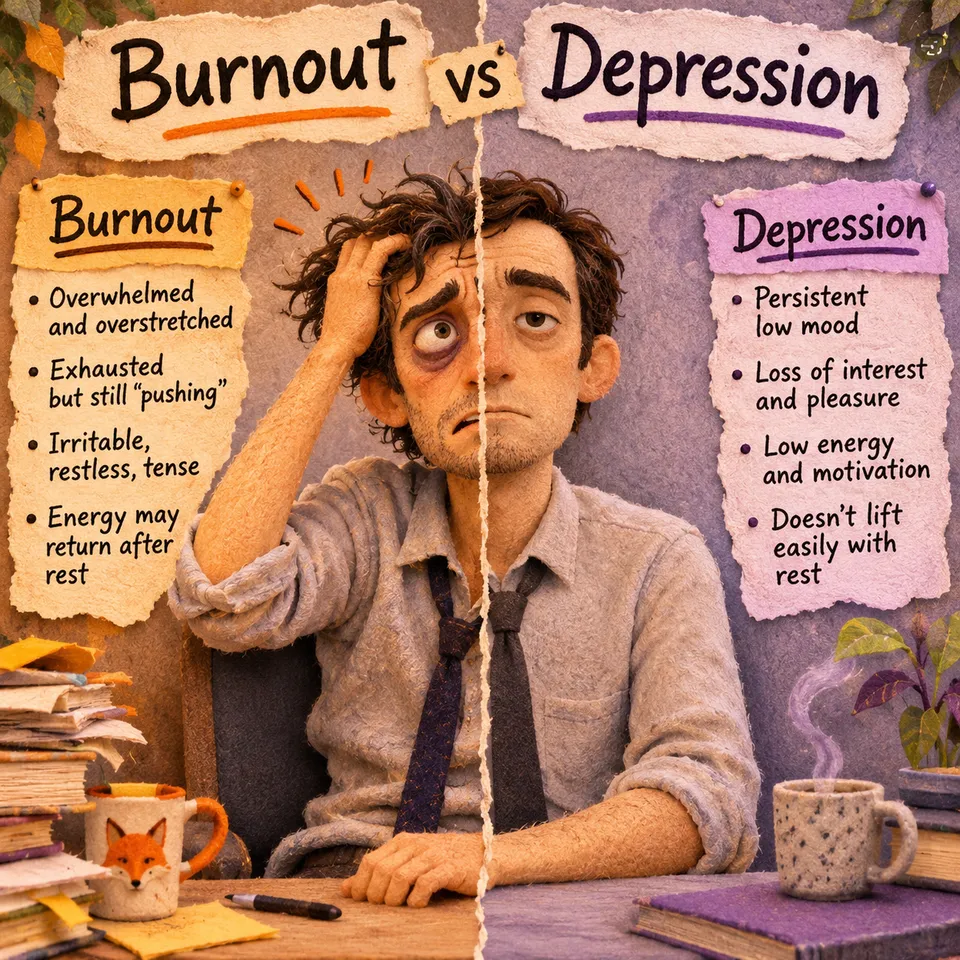
You are tired in a way sleep does not fix. Work feels like wading through wet sand, and you have started to wonder whether the problem is your job or whether the problem is you. Burnout vs depression is the question you keep typing into your phone at midnight, and the answers never quite settle it.
Let's try to settle it a little.
What burnout actually is
The World Health Organization describes burnout in ICD-11 as an occupational phenomenon, not a medical condition. It has three dimensions: exhaustion, growing mental distance or cynicism toward your job, and a sense that you are no longer effective at it.
Notice the frame. The WHO is explicit that burnout refers to the work context and should not be used to describe other areas of life. Christina Maslach, who built the measurement most researchers use, argues in The Burnout Challenge that burnout is a mismatch between a person and their job, not a defect in the person.
Burnout is a relationship problem between you and your work.
What depression looks like
Depression does not care where you are. The National Institute of Mental Health lists persistent low or empty mood, loss of interest in things you used to enjoy, changes in sleep and appetite, trouble concentrating, feelings of worthlessness, and sometimes thoughts of death. For a diagnosis, symptoms are present most of the day, nearly every day, for at least two weeks.
The key word is pervasive. Depression follows you to the weekend, to the holiday, to the friend's kitchen table. The colour drains from everything, not just the spreadsheet.
Depression colours the whole room; burnout colours one chair.
Is burnout just depression with a nicer name?
Fair question, and researchers ask it too. A review by Bianchi, Schonfeld and Laurent found the distinction between the two conceptually fragile, with evidence for burnout's separateness inconsistent. Severe burnout and depression can look nearly identical on paper.
So the honest answer is: they overlap, and the overlap grows the longer burnout goes untreated. Think of it less as two boxes and more as two rivers that share a delta.
This is where Beef is useful. Danny and Amy are both running on empty, both performing fine-ness, both one road-rage incident away from collapse. But watch what happens when they leave work. Amy's dread follows her into her beautiful house and her meditation app. Danny's seems to lift the moment he is on a church pew singing, until the contractor's phone rings again. The show never names either condition. It just lets you watch where the exhaustion lives.
The overlap is real, so look at where the heaviness travels.
Why the difference changes what you do
If what you have is burnout, the medicine is mostly structural: fewer hours, a changed role, a boundary with a manager, a different job. Rest helps, and so does distance from the source. Reading your inner life with the emotion map can show you that the heaviness is specific, aimed, and tied to a place.
If what you have is depression, quitting your job may change nothing, and the loss of structure can make it worse. What helps is treatment: therapy, sometimes medication, and people who notice you.
One rough test. Imagine a fully funded three-month leave starting Monday. If your chest loosens at the thought, you are probably closer to burnout. If the thought lands flat, or frightens you because you would be alone with yourself, take that seriously.
Burnout asks you to change the situation; depression asks you to get support.
Try this with a card
Metaphoric cards are good at bypassing the tired, defended part of you that keeps saying "I'm fine."
- Draw. Pull one card at random and set it where you can see it. Do not pick; let the deck choose.
- Look. Spend a full minute with the image before you think. Where is the weight in it? Where is the light? Is anything moving, or is everything still?
- Two questions. First: If this card were my Monday morning, what would it be? Second: If this card were my Sunday afternoon, what would it be? If the card changes meaning between the two questions, your heaviness has a location. If it stays exactly the same, it may have moved in with you.
Write down both answers. They tend to be clearer than you expect.
If you have had low mood most days for two weeks or more, or any thoughts of not wanting to be here, please speak to a doctor or therapist rather than waiting for the job to fix itself.
Whichever river you are in, you can start by drawing a card.